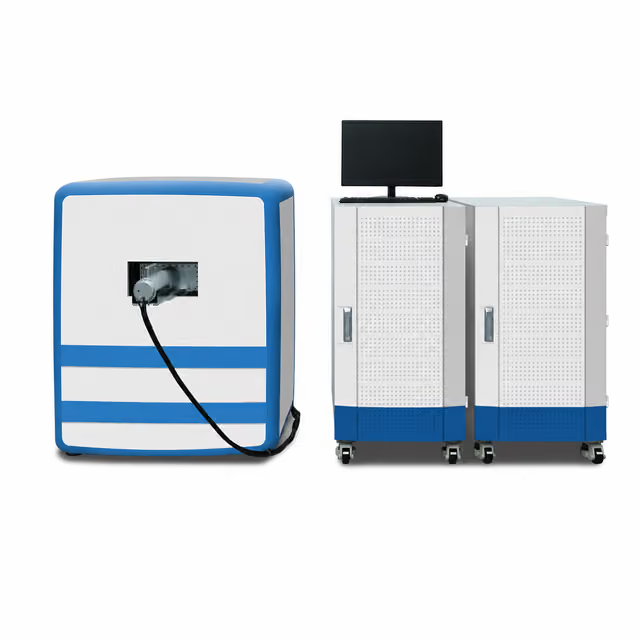
MesoScan NMR Imaging & Analysis System (23 MHz)
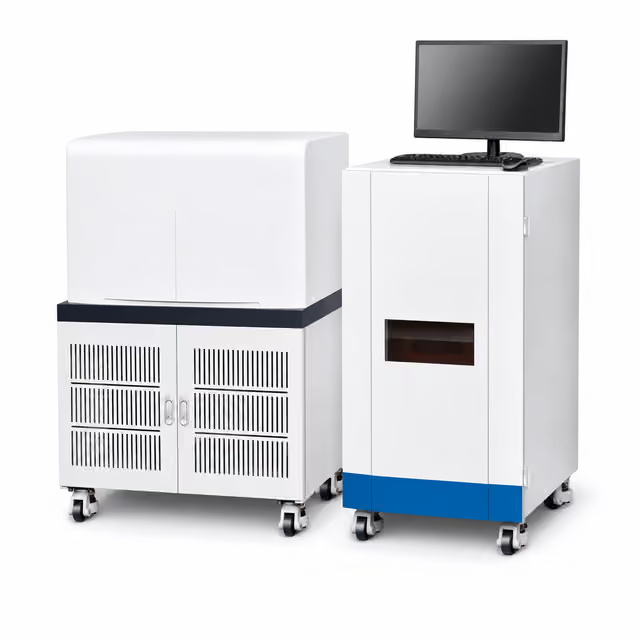
0.5 Tesla NMR system with 2D/3D MRI imaging capabilities and modular temperature/pressure extensions for geological and petroleum research applications.

Louise Corscadden, PhD
Director of Science · ConductScience
Ask Louise about MesoScan NMR Imaging & Analysis System (23 MHz) fit, setup, configuration, or quote prep.
Already working with us? Sign in to connect this with My Scientist.
Key Specifications
Full details →- Model fit
- Configured during quote
- SKU family
- NMS-MESOMR-23
- Shipping box
- 80.0 x 60.0 x 80.0 cm
- Ordering
- Online checkout and quote request available
- Category
- MRI Systems
- Build notes
- Confirm accessories, station layout, and support needs before purchase
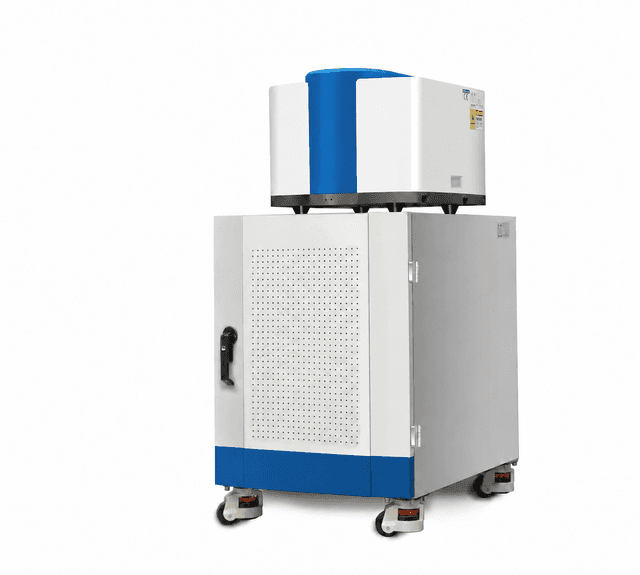
The MesoScan NMR Imaging & Analysis System operates at 0.5 Tesla field strength (23 MHz proton frequency) with a 60 mm bore diameter, providing both relaxation analysis and 2D/3D MRI imaging capabilities in a single platform. This system combines traditional NMR relaxometry measurements with spatial imaging, enabling comprehensive characterization of porous media and fluid dynamics in geological samples.
The system supports modular hardware extensions including high-temperature/high-pressure modules capable of operating up to 40 MPa and low-temperature modules, allowing researchers to simulate reservoir conditions during NMR measurements. The platform is designed for core plug analysis, cement hydration studies, and wettability characterization where both bulk relaxation properties and spatial heterogeneity information are required.
How It Works
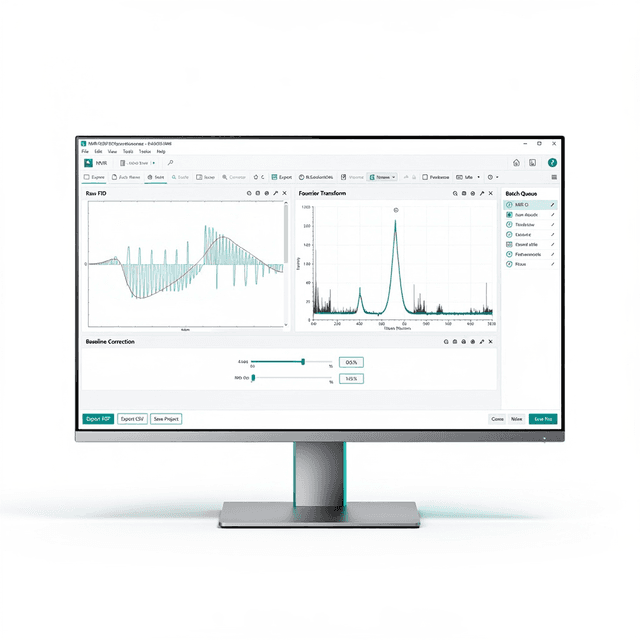
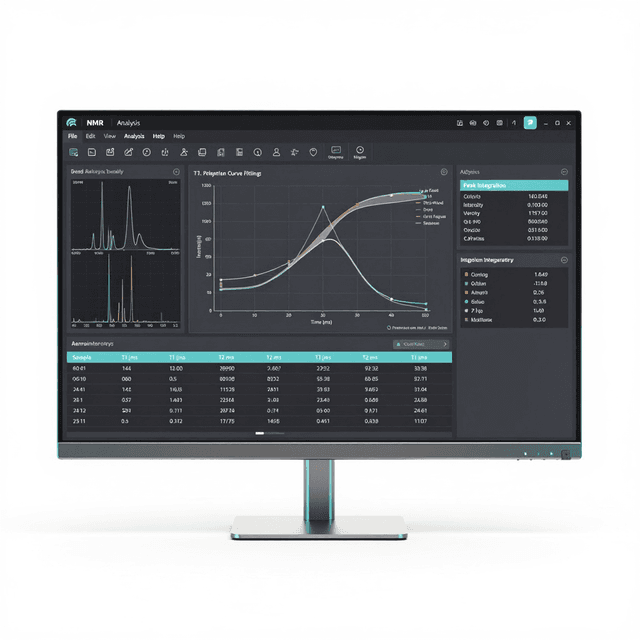
Nuclear magnetic resonance imaging operates by placing samples in a strong magnetic field (0.5 Tesla), causing hydrogen nuclei to align with the field. Radiofrequency pulses at the Larmor frequency (23 MHz for protons at this field strength) excite these nuclei, and the subsequent relaxation signals are detected as the nuclei return to equilibrium. The system measures both T1 (longitudinal) and T2 (transverse) relaxation times, which provide information about molecular mobility and surface interactions.
For imaging applications, magnetic field gradients are applied in three spatial dimensions, causing the resonance frequency to vary with position. By systematically varying these gradients and applying Fourier transform analysis to the acquired signals, the system reconstructs 2D or 3D images showing spatial variations in proton density and relaxation properties. The 60 mm bore diameter accommodates standard core plug samples while maintaining sufficient gradient strength for spatial resolution.
The modular design allows integration of temperature and pressure control systems, enabling measurements under simulated reservoir conditions up to 40 MPa pressure. This capability is essential for studying how fluid properties and rock-fluid interactions change under realistic subsurface conditions.
Features & Benefits
Field Strength
- 0.5 T (23 MHz)
Bore Diameter
- 60 mm
Imaging
- 2D/3D MRI
Automation Level
- semi-automated
Brand
- Greenwaves Scientific
Research Domain
- Analytical Chemistry
- Environmental Monitoring
- Materials Science
Shipping weight
- 800.0 lb
Shipping box
- L: 80.0 cm
- W: 60.0 cm
- H: 80.0 cm
| Feature | This Product | Typical Alternative | Advantage |
|---|---|---|---|
| Magnetic Field Strength | 0.5 Tesla (23 MHz) | Entry-level systems often operate at 0.2-0.3 Tesla fields | Higher field strength improves signal-to-noise ratio and measurement precision for quantitative analysis. |
| Bore Diameter | 60 mm diameter | Benchtop systems commonly offer smaller bore sizes | Accommodates standard core plug dimensions without sample modification or size constraints. |
| Imaging Capability | 2D/3D MRI imaging | Many NMR systems provide only bulk relaxation measurements | Spatial imaging reveals heterogeneity and fluid distribution patterns invisible to bulk measurements. |
| Pressure Rating | HTHP module up to 40 MPa | Standard systems typically operate at atmospheric pressure | High-pressure capability enables realistic reservoir condition simulation for accurate fluid behavior studies. |
| Temperature Control | Modular high and low temperature options | Basic systems often have limited temperature control | Extended temperature range enables studies of thermal effects on fluid properties and rock-fluid interactions. |
| Measurement Modes | Combined relaxation analysis and MRI imaging | Dedicated systems typically focus on either relaxometry or imaging | Integrated platform eliminates need for multiple instruments and enables correlation between bulk and spatial properties. |
The MesoScan system combines NMR relaxometry with MRI imaging at 0.5 Tesla field strength, offering comprehensive porous media characterization. The 60 mm bore accommodates standard core samples while modular pressure/temperature extensions enable reservoir condition simulation up to 40 MPa.
Practical Tips
Perform daily field stability checks using a standard water reference sample before beginning sample measurements.
Why: Field drift can significantly affect relaxation time quantification and measurement reproducibility.
Keep the bore tube and sample area clean and dry between measurements to prevent cross-contamination.
Why: Residual fluids can contribute unwanted signals and affect subsequent measurement accuracy.
Allow samples to reach thermal equilibrium with the measurement temperature before data acquisition.
Why: Temperature variations affect relaxation times and can introduce measurement artifacts during acquisition.
If signal quality degrades, check for nearby ferromagnetic objects or new sources of RF interference.
Why: The NMR measurement is sensitive to magnetic field disturbances and radio frequency noise.
Use multiple signal averages for samples with low proton content to improve signal-to-noise ratio.
Why: Geological samples often have limited fluid content requiring longer acquisition times for adequate sensitivity.
Verify pressure vessel integrity and relief valve operation before high-pressure measurements.
Why: High-pressure modules require careful inspection to prevent equipment damage or safety hazards.
Document sample saturation history and preparation methods for reproducible measurements.
Why: Sample preparation significantly affects NMR results and proper documentation enables measurement validation.
Verify imaging gradient calibration using phantom samples with known geometric dimensions.
Why: Accurate spatial measurements require properly calibrated gradient systems for dimensional accuracy.
Setup Guide
What’s in the Box
- MesoScan NMR main console unit
- Magnet assembly with bore tube
- RF probe and sample holder system
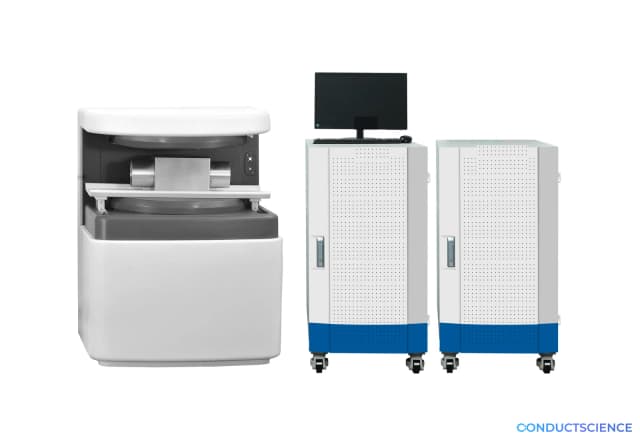
- Computer workstation with analysis software
- Standard reference samples for calibration
- Power cables and interconnect hardware
- User manual and installation guide
- Site preparation specifications (typical)
Warranty
ConductScience provides a standard 1-year manufacturer warranty covering parts and labor, with technical support for installation and operation training.
Compliance
What sample sizes are compatible with the 60 mm bore diameter?
The system accommodates standard 1-inch (25.4 mm) and 1.5-inch (38.1 mm) diameter core plugs with lengths up to approximately 50 mm, leaving clearance for sample holders and potential pressure vessels.
How does the 23 MHz frequency compare to higher-field systems for geological samples?
The 23 MHz frequency provides adequate sensitivity for most geological applications while offering better penetration depth in conductive samples and reduced susceptibility artifacts compared to higher-field systems.
What spatial resolution can be achieved with the imaging capability?
Spatial resolution depends on sample properties and measurement time, but typical values range from 100-500 micrometers for geological samples, consult product datasheet for specific imaging protocols.
Can the system measure both water and oil phases simultaneously?
Yes, the system can differentiate between water and oil phases through relaxation time differences and chemical shift when appropriate pulse sequences are used.
What maintenance requirements should be expected for the magnet system?
Permanent magnet systems typically require minimal maintenance beyond temperature stability monitoring and periodic field homogeneity checks, consult service manual for detailed schedules.
How quickly can pressure/temperature conditions be changed during experiments?
Equilibration times depend on sample properties and desired conditions, but typical pressure changes require 15-30 minutes for stabilization before measurement acquisition.
What data formats are provided for analysis and export?
The system typically provides standard NMR data formats compatible with common analysis software packages, consult technical specifications for specific format details.
Have a question about this product?
Have a question? Just ask.
Send it over and we'll email you a personalized answer — no call, no scheduling.
Prefer to talk it through?
Accessories
Enhance your setup with compatible accessories
Frequently Bought Together