New Pen Type TDS Meter
Portable pen-type TDS and conductivity meter measuring 0-9999 ppm TDS and 0-9999 μS/cm conductivity with ±2% accuracy for field water quality analysis.

Louise Corscadden, PhD
Director of Science · ConductScience
Ask Louise about New Pen Type TDS Meter fit, setup, configuration, or quote prep.
Already working with us? Sign in to connect this with My Scientist.
Key Specifications
Full details →- Model fit
- Configured during quote
- SKU family
- CS-LH-TDS007
- Shipping box
- 6.46 x 0.98 x 0.63 cm
- Ordering
- Online checkout and quote request available
- Category
- Portable Analyzers
- Build notes
- Confirm accessories, station layout, and support needs before purchase
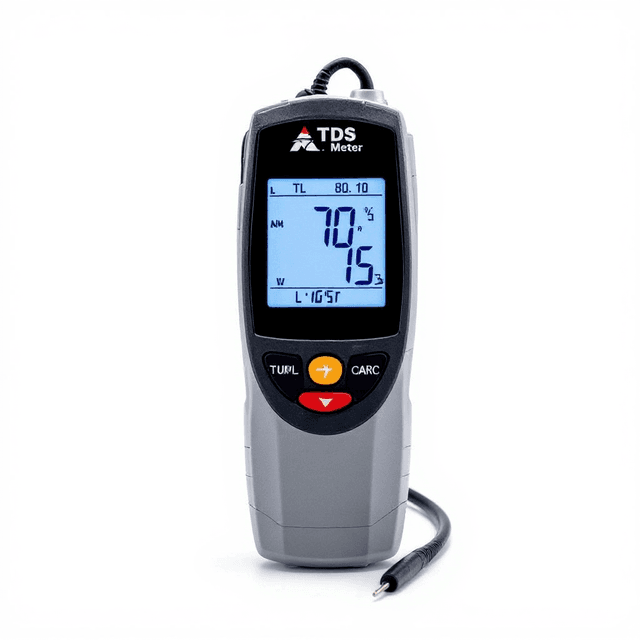
The New Pen Type TDS Meter is a portable conductivity and total dissolved solids analyzer designed for rapid water quality assessment in field and laboratory environments. The instrument measures TDS from 0-9999 ppm (mg/L) and conductivity from 0-9999 μS/cm with ±2% accuracy across a temperature range of 0-80°C. Its compact pen-type design (164×25×16 mm, 26.5g) enables single-handed operation for point-of-use testing.
The meter utilizes the conductivity method for TDS determination, measuring the electrical conductance of dissolved ions in aqueous solutions. Built-in temperature compensation ensures consistent readings across varying environmental conditions. The instrument operates on dual AG13 button batteries, providing extended field deployment capability without external power requirements. Digital display provides immediate readouts for quantitative analysis of water quality parameters.
How It Works
The TDS meter employs the electrical conductivity method to quantify dissolved solids indirectly. When ions dissolve in water, they dissociate into charged particles that enable electrical current flow. The instrument applies a small AC voltage across two electrodes immersed in the sample, measuring the resulting current flow. Higher concentrations of dissolved ions increase conductivity proportionally.
The microprocessor converts conductivity measurements to TDS values using an empirical conversion factor (typically 0.55-0.9 depending on solution composition). Built-in temperature compensation algorithms account for the temperature dependence of ionic mobility, ensuring accurate readings across the 0-80°C operating range. The digital display provides real-time values in ppm (mg/L) for TDS and μS/cm for conductivity.
The measurement principle is limited to ionized dissolved solids. Non-ionic contaminants such as organic compounds, bacteria, or viruses do not contribute to electrical conductivity and are not detected by this method. For comprehensive water quality analysis, supplementary analytical techniques are required.
Features & Benefits
Name
- tds water tester
Type
- Water quality analyzer
Measuring range
- TDS: 0-9999ppm (mg/L),Conductivity:0-9999us/cm
Accessories
- 1 TDS meter1 manual
Applied range
- TDS meter is a easy tool for testing the level of water quality, popular in water deal industry, household, travlling, and etc.
Usage Situation
- drinking water, water filters, hydroponics, aquariums, food & coffee, pools & spas.
Automation Level
- manual
Brand
- ConductScience
Accuracy
- TDS: ±2%(F.S)
Weight
- 26.5g
Dimensions
- 164mmx25mmx16mm
Temperature Range
- 0°C~80°C,32~176â
Power/Voltage
- 2*1.5V ( AG13 button battery)
Research Domain
- Analytical Chemistry
- Environmental Monitoring
- Food Science
- Industrial Hygiene
- Microbiology
- Pharmaceutical QC
Shipping weight
- 0.02 lb
Shipping box
- L: 6.46 cm
- W: 0.98 cm
- H: 0.63 cm
| Feature | This Product | Typical Alternative | Advantage |
|---|---|---|---|
| Measurement Range | TDS: 0-9999 ppm, Conductivity: 0-9999 μS/cm | Entry-level models often limited to 0-2000 ppm TDS range | Extended range eliminates sample dilution requirements for high-mineralization samples commonly encountered in industrial monitoring. |
| Temperature Range | 0-80°C operating range with automatic compensation | Basic models typically operate 0-50°C without compensation | Wider temperature range enables measurement of hot process samples and outdoor applications in extreme conditions. |
| Physical Design | 164×25×16 mm, 26.5g pen-type form factor | Larger handheld units often exceed 100g weight | Compact design reduces operator fatigue and enables convenient pocket storage for field sampling campaigns. |
| Power Supply | 2×AG13 button batteries | 9V battery or rechargeable systems with shorter field life | Button battery configuration provides extended operational time and reduces replacement frequency in remote locations. |
| Dual Display | Simultaneous TDS and conductivity readouts | Single parameter display requiring mode switching | Simultaneous display eliminates measurement delays and reduces potential for transcription errors during data collection. |
| Accuracy Specification | ±2% full-scale accuracy | Entry-level instruments often specify ±3-5% accuracy | Higher accuracy supports quality control applications requiring documented measurement uncertainty. |
The TDS meter combines extended measurement range with compact portability and temperature compensation. The wide operating temperature range and dual-parameter display provide advantages for field deployment while maintaining laboratory-grade accuracy specifications.
Practical Tips
Calibrate with standards that bracket your expected sample range, using 1413 μS/cm for mid-range samples and 12,880 μS/cm for high-conductivity applications.
Why: Bracketing improves accuracy by minimizing extrapolation errors beyond the calibration range.
Rinse electrode with distilled water between samples and store with protective cap containing a few drops of calibration solution.
Why: Prevents electrode contamination and maintains sensor hydration for stable baseline readings.
Allow samples to equilibrate to room temperature when possible, as rapid temperature changes can cause measurement drift.
Why: Temperature compensation algorithms work most effectively when thermal gradients are minimized.
Record sample temperature along with TDS/conductivity values, even though temperature compensation is automatic.
Why: Temperature data enables quality assessment of measurements and troubleshooting of anomalous readings.
If readings appear unstable, check for air bubbles on the electrode surface and ensure adequate immersion depth.
Why: Air bubbles create high-resistance pathways that interfere with conductivity measurements.
Avoid measuring samples with pH <2 or >12, as extreme pH can damage the electrode and affect measurement accuracy.
Why: Extreme pH conditions can cause electrode degradation and dissolution of sensor materials.
For samples with high organic content, compare TDS readings with gravimetric analysis to assess measurement bias.
Why: Conductivity-based TDS underestimates total dissolved matter when significant non-ionic organics are present.
Verify calibration stability by measuring the same standard solution before and after each sampling session.
Why: Calibration drift detection ensures data quality and indicates when recalibration is necessary.
Setup Guide
What’s in the Box
- TDS meter (main unit)
- User manual
- Protective electrode cap (typical)
- Battery installation (2×AG13 button batteries) (typical)
Warranty
ConductScience provides a standard one-year manufacturer warranty covering defects in materials and workmanship, with technical support for calibration and operational questions.
Compliance
What is the detection limit for low-conductivity samples such as ultrapure water?
The 0-9999 μS/cm range accommodates ultrapure water measurements, though accuracy is optimized for samples >10 μS/cm. For critical low-conductivity applications, consult product datasheet for detection limits.
How does temperature affect TDS measurements and is compensation automatic?
The instrument includes built-in temperature compensation algorithms that adjust conductivity readings across the 0-80°C range. Temperature effects on ionic mobility are automatically corrected for accurate TDS calculations.
Can this meter distinguish between different types of dissolved ions?
No, the conductivity method provides total ionic content but cannot differentiate between specific ion species. For ion-specific analysis, use ion-selective electrodes or analytical techniques such as IC or ICP-MS.
What calibration standards are recommended for this measurement range?
Use NIST-traceable conductivity standards at 84, 1413, and 12,880 μS/cm to cover the full measurement range. Calibrate using standards that bracket your expected sample values.
How often should the electrode be replaced or reconditioned?
Electrode lifespan depends on sample matrix and usage frequency. Replace if readings drift beyond ±2% specification after cleaning and recalibration. Consult manual for electrode maintenance procedures.
Is the instrument suitable for samples containing organic solvents?
No, the meter is designed for aqueous samples only. Organic solvents can damage the electrode and affect conductivity measurements. Use only with water-based samples.
What is the relationship between the TDS reading and actual gravimetric TDS?
TDS values are calculated from conductivity using an empirical conversion factor. The relationship varies with ionic composition. For precise TDS determination, compare with gravimetric analysis (Standard Methods 2540 C).
Can measurements be logged or exported for data analysis?
This model provides digital display only. For automated data logging, consider models with USB connectivity or integrate with laboratory information management systems through manual data entry.
Have a question about this product?
Have a question? Just ask.
Send it over and we'll email you a personalized answer — no call, no scheduling.
Prefer to talk it through?
Accessories
Enhance your setup with compatible accessories