Laboratory Animal Water Bottles
Build a cage-level watering setup around the animals, housing system, water demand, and routine bottle-change schedule.
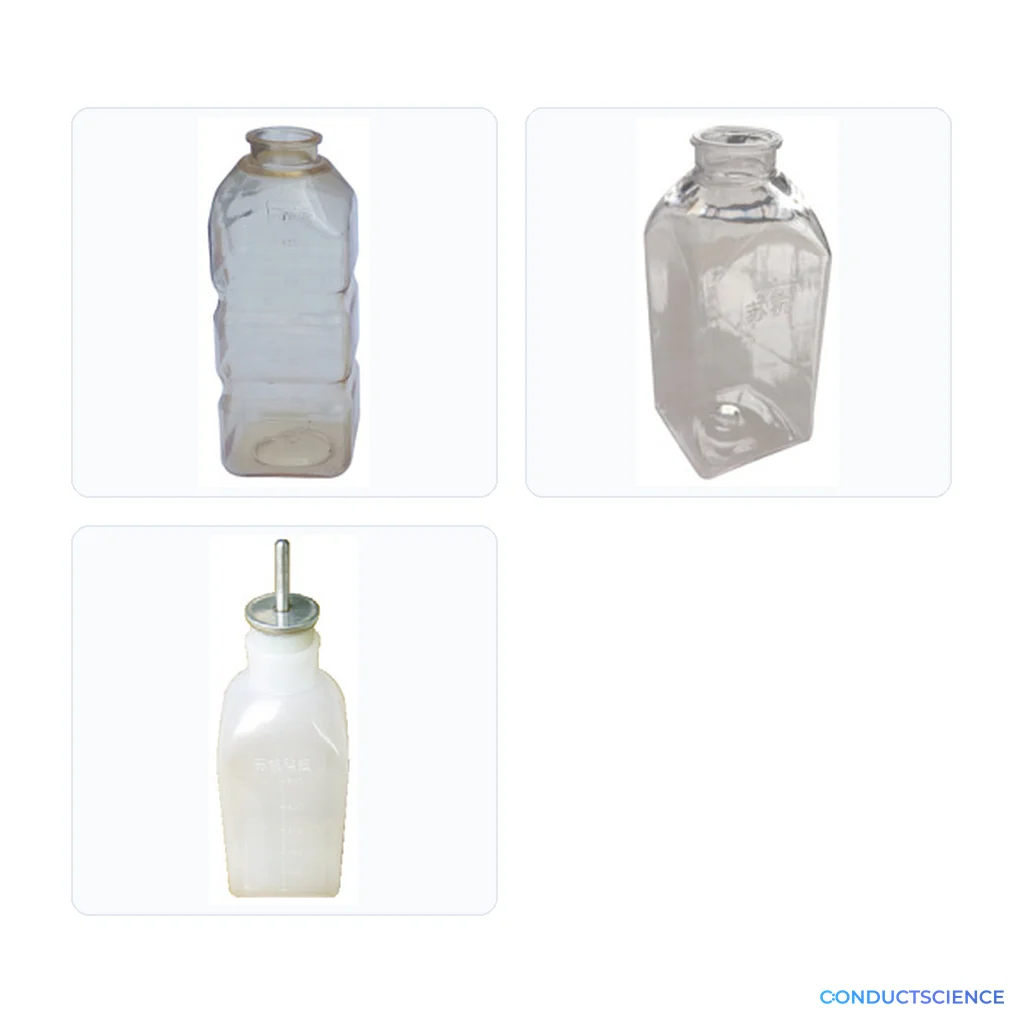
Choose among 13 PP, PC, and PSU bottle configurations from 200 to 700 mL, then pair the bottle with one of five listed stopper designs. ConductScience confirms bottle-neck fit, cage connection, sanitation needs, and pack quantity during quote review.

Louise Corscadden, PhD
Director of Science · ConductScience
Ask Louise about Laboratory Animal Water Bottles fit, setup, configuration, or quote prep.
Already working with us? Sign in to connect this with My Scientist.
Key Specifications
Full details →- Available materials
- PP, PC, PSU
- Available volumes
- 200 mL, 250 mL, 400 mL, 500 mL, 700 mL
- Bottle configuration count
- 13
- Available stopper configurations
- Straight rubber, Straight silicone, Bent-tube rubber, Bent-tube silicone, Stainless steel
Build a reliable cage-level watering routine
Laboratory animal water bottles give a facility direct control over drinking-water delivery at the cage level. They are useful when each cage needs its own removable water supply for routine exchange, sanitation, observation, or study-specific handling. A removable bottle also gives animal-care teams a clear point for checking water availability and replacing the supply according to the approved husbandry schedule.
Bottle volume affects how the watering routine fits animal demand and the planned change-out schedule. This family covers capacities from 200 to 700 mL, so teams can choose a smaller or larger supply around the housing configuration instead of treating every cage as the same use case. Selection should account for the animal, cage population, expected use, observation frequency, and the facility's response plan if a bottle is empty or disconnected.
Material selection matters at the facility level. PP, PC, and PSU options let a team match new bottles to its existing cage-room standard, cleaning workflow, and replacement inventory. The 13 listed bottle configurations preserve only the recorded material and volume combinations. Standardizing a compatible configuration can simplify stocking, bottle rotation, staff training, and replacement without implying that every material uses the same sanitation process.
The watering interface is part of the same decision. Five listed stopper configurations are available: straight rubber, straight silicone, bent-tube rubber, bent-tube silicone, and stainless steel. These are compatibility components rather than separate research products, so they are reviewed with the bottle family. The correct choice depends on the bottle neck, tube arrangement, cage connection, and the way staff remove, inspect, clean, and reinstall the complete assembly.
Before ordering, map the full cage-room cycle from clean storage through filling, distribution, in-cage use, collection, inspection, sanitation, and return to service. Confirm that the selected capacity does not interfere with cage access or observation and that staff can identify damaged or incorrectly seated components during rounds. ConductScience will confirm bottle and stopper compatibility, pack quantity, what is included, and any remaining connection details during quote review so the order supports a workable husbandry setup.
How It Works
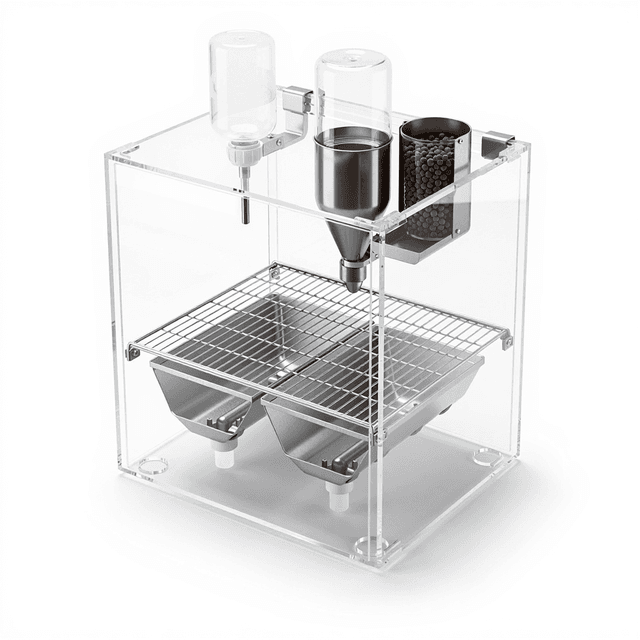
The water delivery system operates through gravity-fed flow control, where water descends from the inverted bottle through a sipper tube assembly containing a ball-bearing valve mechanism. When animals contact the drinking valve with their tongue or lips, the ball bearing is displaced, creating a small opening that allows controlled water release. Surface tension and capillary action within the sipper tube prevent continuous dripping when the valve returns to the closed position.
The polymer bottle construction provides chemical inertness against most laboratory compounds while maintaining optical clarity for visual assessment of water levels and consumption patterns. The autoclavable design withstands repeated sterilization cycles at 121°C, ensuring pathogen-free water delivery in barrier and SPF facilities. Integration with cage rack systems is achieved through standardized mounting clips that secure the bottle to cage lids while positioning the sipper tube at optimal height for species-appropriate access.
Features & Benefits
Available materials
- PP
- PC
- PSU
Available volumes
- 200 mL
- 250 mL
- 400 mL
- 500 mL
- 700 mL
Bottle configuration count
- 13
Available stopper configurations
- Straight rubber
- Straight silicone
- Bent-tube rubber
- Bent-tube silicone
- Stainless steel
| Feature | This Product | Typical Alternative | Advantage |
|---|---|---|---|
| Material Construction | Polycarbonate (PC) or Polysulfone (PSU) polymer | Glass bottles are common but present breakage risks | Eliminates safety hazards from broken glass while maintaining transparency for visual monitoring. |
| Sterilization Compatibility | Autoclavable at 121°C | Some plastic bottles may not withstand autoclave temperatures | Supports sterile protocols required in barrier and pathogen-free facilities. |
| System Compatibility | IVC, EVC, and open-cage rack systems | Some bottles are designed for specific cage types only | Reduces inventory complexity by working across multiple housing systems. |
| Species Range | Mouse, Rat, Guinea Pig compatibility | Single-species designs may require different bottles for each animal type | Simplifies procurement and storage for facilities housing multiple rodent species. |
| Operation Method | Manual gravity-fed system | Automated systems offer more features but require power and maintenance | Provides reliable operation without external dependencies or complex failure modes. |
The bottles combine polymer durability with autoclave compatibility and broad system integration. The manual design prioritizes reliability and simplicity over automated features, making them suitable for facilities requiring dependable hydration delivery across diverse research protocols.
| Model | SKU | Listed price | Status | Shipping box |
|---|---|---|---|---|
| PSU | CS-GEN-00003-PSU-700ML | Quote | Available | Confirmed during quote |
| PSU | CS-GEN-00003-PSU-500ML | Quote | Available | Confirmed during quote |
| PSU | CS-GEN-00003-PSU-400ML | Quote | Available | Confirmed during quote |
| PSU | CS-GEN-00003-PSU-250ML | Quote | Available | Confirmed during quote |
| PC | CS-GEN-00003-PC-700ML | Quote | Available | Confirmed during quote |
| PC | CS-GEN-00003-PC-500ML | Quote | Available | Confirmed during quote |
| PC | CS-GEN-00003-PC-400ML | Quote | Available | Confirmed during quote |
| PC | CS-GEN-00003-PC-250ML | Quote | Available | Confirmed during quote |
| PP | CS-GEN-00003-PP-700ML | Quote | Available | Confirmed during quote |
| PP | CS-GEN-00003-PP-500ML | Quote | Available | Confirmed during quote |
| PP | CS-GEN-00003-PP-400ML | Quote | Available | Confirmed during quote |
| PP | CS-GEN-00003-PP-250ML | Quote | Available | Confirmed during quote |
| PP | CS-GEN-00003-PP-200ML | Quote | Available | Confirmed during quote |
Practical Tips
Establish regular bottle replacement schedules based on sterilization frequency and visual wear indicators.
Why: Prevents potential failures that could compromise animal welfare or study integrity.
Pre-test compound solubility and stability in the intended water source before beginning dosing studies.
Why: Ensures consistent drug delivery and prevents precipitation that could block sipper tubes.
Validate consumption measurement accuracy by weighing bottles before and after known consumption periods.
Why: Establishes baseline accuracy for studies requiring precise fluid intake monitoring.
If sipper tube fails to deliver water, check for air bubbles by gently inverting and tapping the bottle.
Why: Air bubbles can disrupt the gravity-fed flow mechanism and prevent proper water access.
Inspect bottles for stress cracks after autoclaving, particularly around threaded connections.
Why: Repeated thermal cycling can weaken polymer structures and lead to unexpected failures.
Record baseline water consumption patterns before introducing experimental variables.
Why: Provides reference data to distinguish treatment effects from normal consumption variations.
Position sipper tubes 2-3 cm above cage floor to prevent contamination while ensuring accessibility.
Why: Optimizes animal access while minimizing bedding contact that could introduce contaminants.
Setup Guide
What’s in the Box
- Selected laboratory animal water bottle configuration
Warranty
ConductScience provides a standard one-year manufacturer warranty covering defects in materials and workmanship. Technical support is available for installation and compatibility questions related to specific cage systems.
Compliance
How should I select bottle volume?
Match the capacity to expected animal demand, the number of animals using the cage, and the facility's planned observation and change-out schedule.
When is bottle-based watering useful?
Water bottles support cage-level water handling and are useful where the facility needs removable, separately managed water supplies rather than a shared automatic line.
Is a stopper included?
Stopper choice and included quantity are confirmed during quote review so the bottle and watering setup can be matched correctly.
How should the bottles be cleaned?
Follow the facility's validated sanitation procedure and confirm that the selected material is compatible with the planned cleaning method.
Have a question about this product?
Have a question? Just ask.
Send it over and we'll email you a personalized answer — no call, no scheduling.
Prefer to talk it through?
Accessories
Enhance your setup with compatible accessories
Frequently Bought Together