Vortex Mixer BJPX-VW
Benchtop orbital vortex mixer with 200-3000 rpm speed range and pressure-sensing control for laboratory sample homogenization and mixing protocols.

Louise Corscadden, PhD
Director of Science · ConductScience
Ask Louise about Vortex Mixer BJPX-VW fit, setup, configuration, or quote prep.
Already working with us? Sign in to connect this with My Scientist.
Key Specifications
Full details →- Model fit
- Configured during quote
- SKU family
- BIO-0602
- Shipping box
- 42.0 x 43.6 x 38.0 cm
- Ordering
- Online checkout and quote request available
- Category
- Benchtop Instruments
- Build notes
- Confirm accessories, station layout, and support needs before purchase
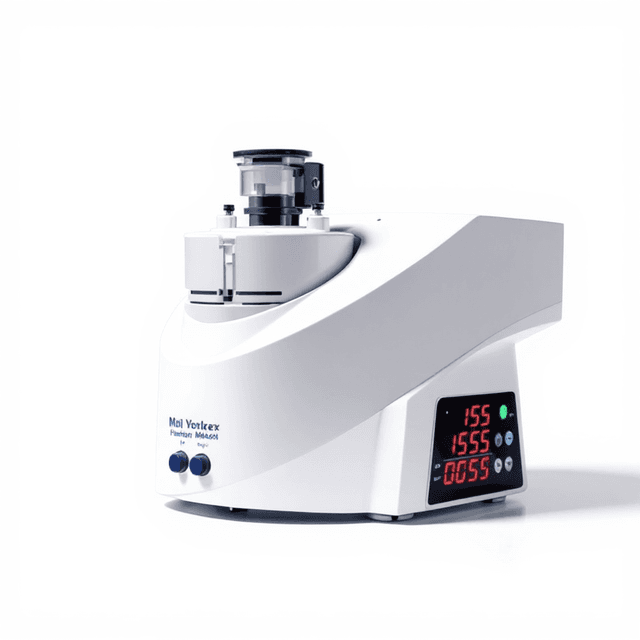
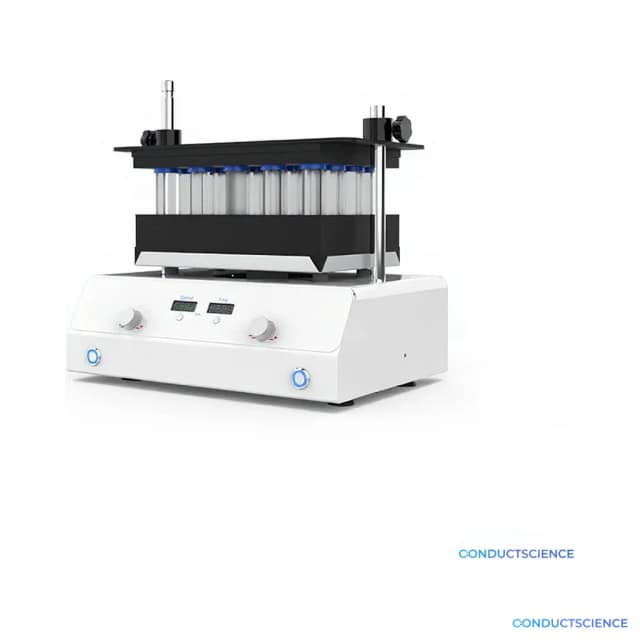
The Vortex Mixer BJPX-VW is a benchtop orbital mixing instrument designed for laboratory sample preparation and homogenization protocols. The system delivers controlled circular motion mixing with 4mm amplitude oscillation at speeds ranging from 200 to 3000 rpm with ±5 rpm precision. The pressure-sensing control interface enables both point vibration and continuous operation modes for versatile sample processing workflows.
This 35W mixer accommodates standard test tubes through the XW001 platform system and provides programmable timing control from seconds to extended multi-hour protocols. The universal power supply (100-240V, 50/60Hz) and compact 280×230×210mm footprint make it suitable for integration into existing laboratory setups across multiple research disciplines requiring consistent sample mixing and homogenization.
How It Works
The vortex mixer operates through controlled orbital motion generated by an offset motor assembly that creates circular oscillation patterns. The 4mm amplitude circular motion imparts kinetic energy to samples through the platform interface, creating turbulent flow patterns within sample containers. This orbital mixing mechanism generates three-dimensional fluid motion that promotes rapid homogenization without the directional limitations of linear mixing systems.
The pressure-sensing control system detects tube contact with the mixing platform and automatically adjusts operation between point vibration and continuous modes. Variable speed control from 200-3000 rpm allows researchers to optimize mixing intensity based on sample viscosity, volume, and fragility considerations. The programmable timer system (0-9999 minutes/seconds) provides reproducible mixing protocols essential for quantitative experimental procedures.
Features & Benefits
Automation Level
- semi-automated
Speed/Accuracy
- 200~3000rpm/±5rpm
Timing
- 0~9999min/s
Amplitude Range
- 4mm
Oscillation Mode
- Circular motion
Working Mode
- Point vibration, continuous
Control Form
- Pressure sensing
Weight
- 7.1kg
Packing Size
- 280mm*230mm*210mm
Type
- Item No.
Mode
- Max Speed
Max Test Tube Size
- Standard/Optional
Test Tube Platform
- XW001
Brand
- ConductScience
Research Domain
- Analytical Chemistry
- Cell Biology
- Food Science
- Materials Science
- Microbiology
- Pharmaceutical QC
Power/Voltage
- 100~240V, 50/60Hz
Shipping weight
- 7.1 lb
Shipping box
- L: 42.0 cm
- W: 43.6 cm
- H: 38.0 cm
| Feature | This Product | Typical Alternative | Advantage |
|---|---|---|---|
| Speed Range and Control | 200-3000 rpm with ±5 rpm precision control | Entry-level models often provide 500-2500 rpm ranges with less precise speed control | Extended speed range accommodates both gentle mixing of fragile samples and vigorous homogenization of viscous solutions with reproducible precision |
| Mixing Motion Type | 4mm amplitude circular orbital motion | Linear vortex motion or smaller amplitude orbital systems | Three-dimensional orbital mixing creates more uniform homogenization patterns compared to directional linear mixing systems |
| Operation Control | Pressure-sensing automatic activation with dual working modes | Manual push-button or touch activation systems | Hands-free operation enables consistent sample processing while freeing researchers for other protocol steps |
| Timer Programming | 0-9999 minutes/seconds programmable digital timer | Basic timers with limited range or manual timing control | Extended timing range supports both rapid mixing protocols and extended homogenization procedures without operator monitoring |
| Power and Efficiency | 35W motor with universal 100-240V power supply | Higher power consumption or region-specific power requirements | Energy-efficient operation with international power compatibility reduces operational costs and installation complexity |
| Footprint and Design | Compact 280×230×210mm benchtop footprint | Larger units requiring more bench space | Space-efficient design maximizes benchtop utilization while maintaining stable operation platform for routine laboratory workflows |
The BJPX-VW combines precise speed control, orbital mixing motion, and pressure-sensing automation in a compact design optimized for routine laboratory sample preparation. The extended speed range and programmable timing provide protocol flexibility while maintaining consistent mixing performance across diverse sample types.
Practical Tips
Verify speed accuracy monthly using a tachometer at 500 rpm intervals across the full range to ensure ±5 rpm specification compliance.
Why: Speed accuracy directly affects mixing efficiency and protocol reproducibility in quantitative experimental procedures.
Clean the platform surface with mild detergent after each use and inspect the orbital motion mechanism quarterly for smooth operation without vibration.
Why: Contamination buildup affects pressure sensing accuracy while mechanical wear can introduce unwanted vibrations that compromise mixing uniformity.
Balance tube loads symmetrically on the platform and use consistent fill volumes to minimize platform stress and ensure uniform mixing patterns.
Why: Unbalanced loads create irregular orbital motion that can lead to inconsistent homogenization and accelerated mechanical wear.
If pressure sensing becomes inconsistent, check platform surface for debris and verify tube contact pressure meets activation threshold requirements.
Why: Inadequate contact pressure prevents automatic activation while surface contamination interferes with proper pressure detection sensitivity.
Document mixing speed, duration, and sample volume for each protocol to ensure experimental reproducibility and optimize mixing parameters for specific applications.
Why: Systematic parameter documentation enables protocol optimization and provides traceability for regulatory compliance requirements.
Ensure tube caps are properly secured and inspect for cracks before mixing to prevent sample spillage and cross-contamination.
Why: Orbital motion can generate significant centrifugal forces that may cause unsecured caps to loosen or damaged tubes to fail during operation.
Allow the motor to reach target speed before starting the timer to ensure consistent mixing energy delivery throughout the programmed duration.
Why: Motor acceleration time can affect total mixing energy if the timer starts before reaching steady-state operation speed.
Lubricate the orbital mechanism annually according to manufacturer specifications to maintain smooth operation and extend mechanical life.
Why: Proper lubrication prevents excessive friction and wear in the orbital drive system that could affect mixing amplitude accuracy.
Setup Guide
What’s in the Box
- Vortex Mixer BJPX-VW main unit
- XW001 test tube platform
- Power cord
- User manual and operation guide
- Warranty documentation (typical)
- Calibration certificate (typical)
Warranty
ConductScience provides a standard one-year manufacturer warranty covering defects in materials and workmanship, with technical support available for operational questions and troubleshooting assistance.
Compliance
What is the maximum sample volume this mixer can effectively homogenize?
Maximum sample volume depends on tube size compatibility with the XW001 platform and mixing efficiency requirements. Consult product datasheet for specific volume recommendations based on container geometry and sample viscosity.
Can the mixing speed be adjusted during operation or must it be preset?
The speed control allows real-time adjustment from 200-3000 rpm during operation with ±5 rpm accuracy, enabling optimization of mixing intensity based on sample behavior observations.
How does the pressure sensing system differentiate between different tube sizes?
The pressure sensing system detects contact pressure rather than tube dimensions, automatically activating mixing when sufficient downward pressure is applied regardless of tube size within platform compatibility limits.
What maintenance is required for consistent mixing performance?
Regular cleaning of the platform surface, periodic inspection of the orbital motion mechanism for wear, and annual speed calibration verification to maintain the ±5 rpm accuracy specification.
Can multiple tubes be mixed simultaneously on the platform?
Multiple tube capacity depends on the specific platform configuration and tube dimensions. The XW001 platform specifications determine maximum simultaneous sample capacity.
What is the noise level during operation at maximum speed?
Operational noise levels are not specified in the technical documentation. Consult product datasheet for acoustic specifications if noise considerations are critical for laboratory placement.
How accurate is the timer system for extended mixing protocols?
The digital timer system provides programming from 0-9999 minutes/seconds with electronic timing accuracy suitable for reproducible laboratory protocols, though specific timing precision is not detailed in specifications.
Have a question about this product?
Have a question? Just ask.
Send it over and we'll email you a personalized answer — no call, no scheduling.
Prefer to talk it through?