ConductVision Enterprise

Optical Character Recognition

ConductVision reads the codes and numbers painted or printed on containers, rail wagons and trailers, and logs each read with its image for yard and terminal teams.

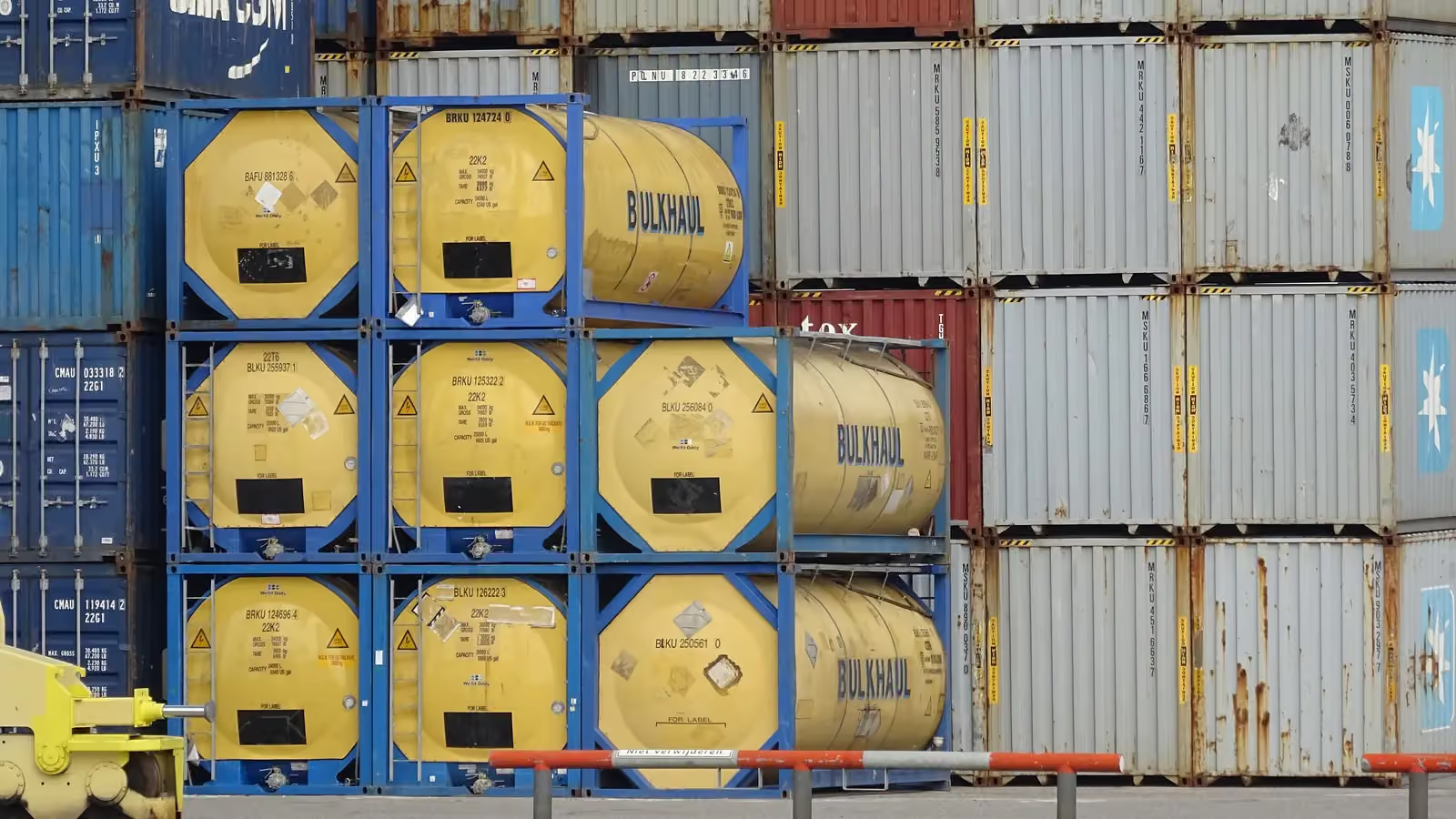
Stacked tank containers at the Port of Rotterdam; boxes mark five container numbers read from the tanks and a box container, including BRKU 124696 4 and BLKU 250561.5 detections
Tank container stack in Rotterdam
  • Text5

ConductVision detections on this photo. Photo: AgainErick, CC BY-SA 4.0, cropped.

Optical Character Recognition reads printed and stenciled text from physical objects captured in video streams or images. The system handles ISO 6346 container codes, warehouse labels, serial numbers on equipment, safety signage, and multilingual text across 40+ languages. Unlike document-focused OCR tools, this system is purpose-built for industrial and field environments where text appears on curved surfaces, under uneven lighting, and at oblique angles. Results are structured and searchable, designed to feed directly into inventory, logistics, and compliance systems.

Outcomes

What your team gets

Wagon numbers read in passing

Clerks walk the length of a train to write down each wagon number before it leaves the yard.

The walk takes time on every train, and one misread number files a wagon under the wrong train.

How
In a pilot, ConductVision reads the stenciled number on each wagon as the train passes a fixed camera.
You get
A train list in wagon order, with the number, time and image for each wagon.

Codes checked against bookings

At the gate, staff compare each container or trailer number with the booking by eye.

A swapped pair of digits lets the wrong unit through or holds the right one at the gate.

How
In a pilot, ConductVision reads the code and checks it against the expected list from the yard system.
You get
A gate log of each code and whether it matched, with the image for each mismatch.

Where each trailer was last seen

Yard staff drive the rows to find a trailer or container by its number.

One search can take a full lap of the yard while a driver waits at the gate.

How
In a pilot, ConductVision reads the numbers on units in view of the yard cameras and records where each was last seen.
You get
A last-seen camera and time for each number, ready to search.

What the model sees

Detections in two more settings

Refrigerated containers stacked on a quay at the Port of Rotterdam; boxes mark eight names read from the container sides, five FRICON and three GEseaco.
Reefer stacks on a Rotterdam quay
  • Text8

ConductVision detections on this photo. Photo: AgainErick, CC BY-SA 4.0, cropped.

Shipping containers stacked on Eling Wharf in Hampshire, England, seen across the water; boxes mark five names read from the containers, four Hapag-Lloyd and one GEseaco.
Container stacks on Eling Wharf
  • Text5

ConductVision detections on this photo. Photo: John Lucas, CC BY-SA 2.0, cropped.

Endpoints

What a pilot measures

Each endpoint is defined before the pilot starts, with what is counted, its unit and how the results are broken down.

What a pilot measures
PrimaryComplete code rateShare of containers, wagons and trailers passing a read point with a complete code read, checked against its check digit where the code has one.Unit:%By:Read point, unit type
SecondaryHand entries leftCodes staff still type by hand because no complete read was made, counted per shift.Unit:codes per shiftBy:Read point
Booking mismatchesCodes read at the gate that differ from the expected list, counted once per arrival.Unit:mismatches per dayBy:Gate, hour
Train list timeMinutes from the last wagon passing the camera to a complete train list.Unit:minutes (median)By:Track

How we check the model

Each pilot measures ConductVision on your own footage against a sample checked by hand, before anyone relies on its numbers.

  • Read accuracy

    Share of codes read that match a reviewer's transcription of the same image, character for character.

    % · by read point, stenciled or printed

  • Missed codes

    Share of codes visible to a reviewer in sampled frames that ConductVision did not find.

    % · by camera, distance band

  • Wrong reads passed

    Reads that pass the check digit but differ from the reviewer's transcription, per 1,000 reads.

    per 1,000 reads · by read point

How it works

Optical Character Recognition in three steps

  1. Connect

    Position Cameras at Read Points

    Mount cameras at container yards, conveyor belts, loading docks, or facility entrances where text needs to be captured. The system calibrates for distance, angle, and expected text regions automatically.

  2. Analyze

    Detect and Extract Text

    A text-detection model localizes text regions in each frame, then a recognition model decodes characters with language-specific dictionaries. Post-processing validates against expected formats like ISO 6346 container codes.

  3. Act

    Structure and Deliver Results

    Extracted text is parsed into structured fields (container number, check digit, owner code) and delivered to downstream systems via API. Misreads are flagged by confidence score for manual review.

What it detects

Classes the models report

  • Text

    Each block of printed or stenciled text in the frame, boxed and read

  • Container code

    Owner code, serial number and check digit, as separate fields

  • Wagon number

    The number on each rail wagon, in the order the train passes

  • Trailer number

    Fleet and unit numbers painted on trailers and swap bodies

Features

What the system does

ISO 6346 Container Code Reading
Reads and validates intermodal container codes including owner code, equipment category, serial number, and check digit. Validates check digits automatically to catch misreads.
Serial Number Extraction
Reads serial numbers, part numbers, and asset tags from equipment, packaging, and components. Handles embossed, stamped, and printed text on metal, plastic, and cardboard surfaces.
Multi-Language Support
Recognizes text in 40+ languages including Latin, Cyrillic, Arabic, Chinese, Japanese, and Korean scripts. Language detection is automatic or can be specified per camera.
Safety Sign and Label Reading
Captures text from safety signs, hazmat placards, and regulatory labels. Useful for compliance verification and automated inventory of posted signage.
Curved and Angled Surface OCR
Perspective correction and dewarping algorithms handle text on cylindrical containers, angled signs, and surfaces viewed at up to 60 degrees from perpendicular.
Batch Image Processing
Upload folders of images for offline text extraction. Results are returned as structured JSON or CSV with image filename, detected text regions, and confidence scores.
Use cases

Where teams put it to work

Container Yard Automation

Shipping terminals process thousands of containers daily and need accurate code reads for tracking. Automated ISO 6346 reading can replace manual data entry at gate lanes and crane operations.

logisticsshipping

Warehouse Inventory Verification

Warehouses need to verify that the right products are in the right locations. Camera-based label reading at dock doors and aisle intersections can catch mis-shipments before they propagate.

logisticsmanufacturingretail

Manufacturing Quality Control

Production lines print lot numbers, date codes, and serial numbers on products. OCR can verify that printed information matches the production order, flagging discrepancies in real time.

manufacturingpharma

Utility Asset Management

Utility companies maintain thousands of poles, meters, and transformers with stamped serial numbers. Mobile and drone-mounted cameras can read asset IDs during inspections, eliminating manual transcription.

utilitiesenergy

Hazmat Placard Identification

Emergency responders and facility managers need to identify hazardous materials quickly. Automated placard reading can extract UN numbers and hazard classes from truck and container signage.

logisticsgovernmentemergency services

Technical overview

Inputs, outputs and hardware

Accuracy and speed are measured on your footage and cameras during the pilot, and reported with the conditions they were measured under.

Models
Text detector and recognizer (CRAFT detection with CRNN recognition) for printed and stenciled text
Input formats
RTSP, ONVIF, MP4, JPEG, PNG, TIFF batch
Output formats
JSON (structured fields), CSV, XML, Webhooks
Hardware
NVIDIA Jetson, Intel NUC, any x86 with a CUDA-capable GPU

Pilot

Evaluate optical character recognition on your footage

A pilot takes one prioritized outcome, runs on your cameras, reports the endpoints above and ends with a results review and a decision.