Spinal Cord Surgical Kit
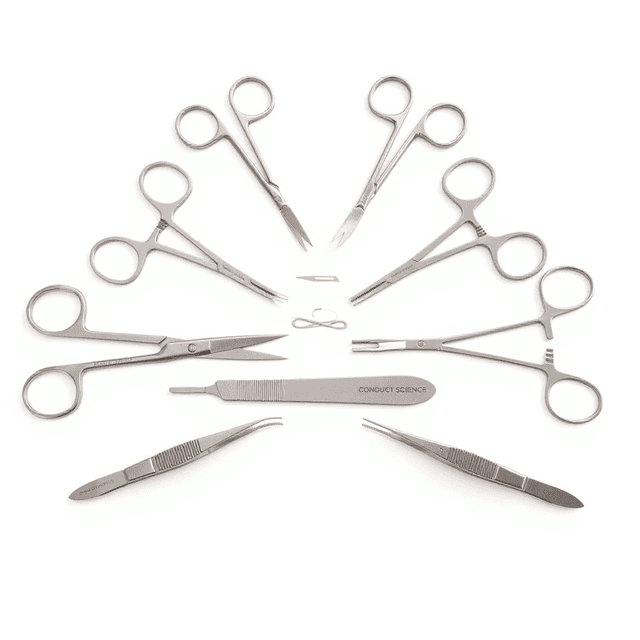
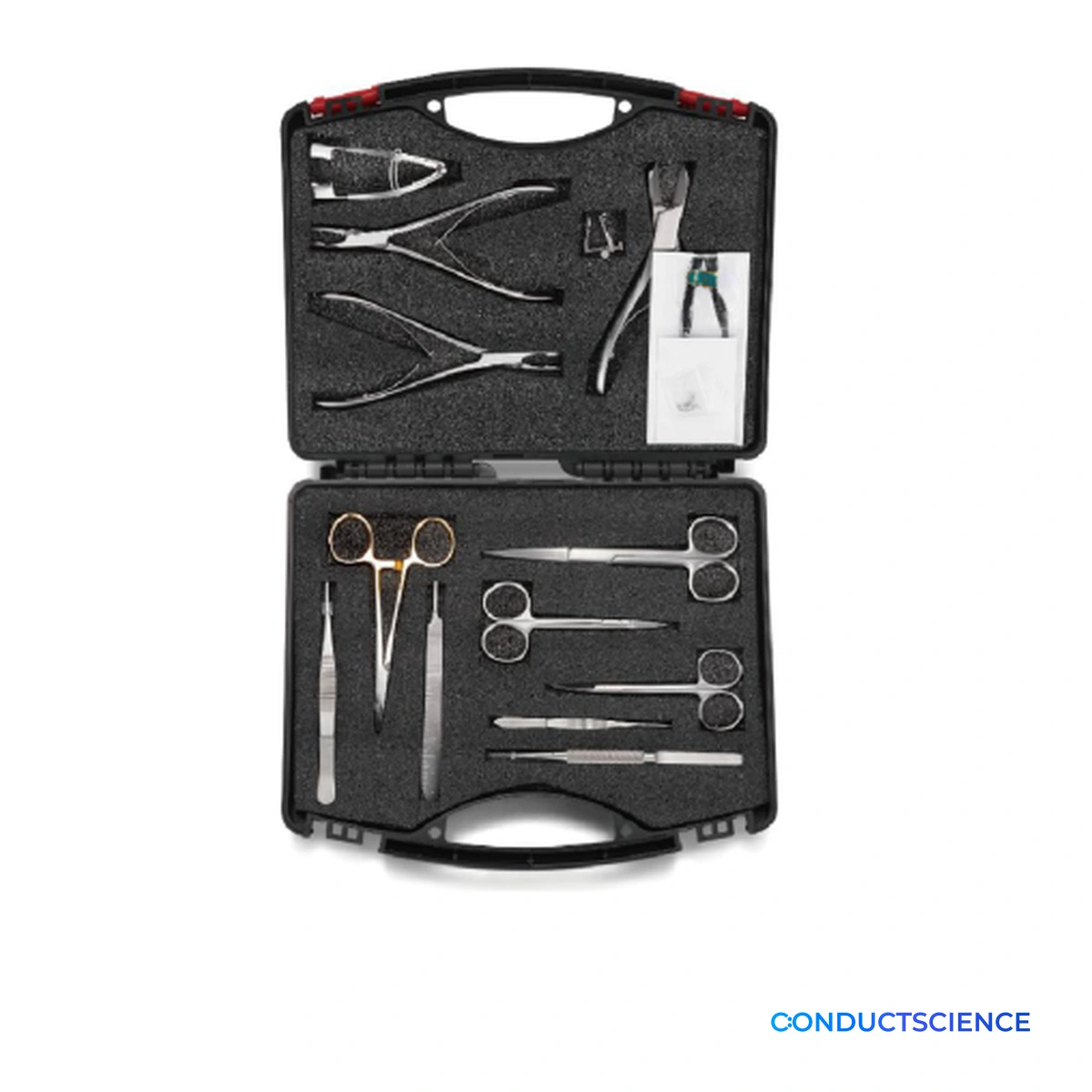
Small-animal spinal cord surgical kit with handle and blades, straight and curved scissors, micro and dissecting tweezers, bone cutters, curved rongeurs, retractors, needle holder, suture needles, and #4-0/#6-0 sutures for spinal exposure, access, and closure planning.

Louise Corscadden, PhD
Director of Science · ConductScience
Ask Louise about Spinal Cord Surgical Kit fit, setup, configuration, or quote prep.
Already working with us? Sign in to connect this with My Scientist.
Key Specifications
Full details →- Model fit
- Configured during quote
- SKU family
- CS-SRG-00008
- Sizing
- Model-specific dimensions confirmed from the selected configuration
- Ordering
- Online checkout and quote request available
- Category
- Surgical Instruments
- Build notes
- 3/8 suture needle pack with #4-0 and #6-0 non-absorbable sutures
Overview
The Spinal Cord Surgical Kit is a small-animal surgical kit for delicate spinal cord procedures in research animals including mice, rats, rabbits, and cats. It is organized around the major stages of a spinal exposure workflow: incision and access, fine tissue handling, bone access, retraction, needle handling, and closure.
The kit includes a #3 surgical handle with ruler, #11 blade pack, straight and curved scissors, straight micro tweezers, eye tweezers, dissecting tweezers, bone cutter, two curved rongeurs, blunt and single-arc retractors, a tungsten-jaw needle holder, 3/8 suture needles, and #4-0/#6-0 non-absorbable sutures. That combination makes it more procedure-specific than a basic cutting and suturing kit.
For spinal cord workflows, the key buying value is exposure planning. Bone cutter, 0.5 mm and 1.0 mm curved rongeur cup sizes, and two retractor styles give the lab more choices for controlled access and field presentation. The fine tweezers and scissors support delicate handling, while the closure materials help procurement plan the end of the workflow at the same time as access and exposure.
Scientific Use
Small-animal spinal cord surgery may support injury-model preparation, controlled exposure, injection, implantation, tissue access, or other neuroscience workflows where positioning and delicate handling matter. A dedicated spinal cord tray helps the team stage access, bone, retraction, and closure tools before animal preparation and helps procurement compare the instrument kit against spinal adaptors, injury devices, and stereotaxic support equipment.
The kit should be planned with the rest of the spinal surgery station: anesthesia, warming, magnification, stereotaxic or spinal fixation support when needed, sterile-field supplies, and recovery monitoring. ConductScience can help match the instrument kit to spinal cord adaptors, spinal cord injury devices, stereotaxic accessories, or surgical support products when the workflow requires fixation, positioning, or controlled injury hardware.
Buying Fit
Choose this kit when the lab needs a spinal-cord-specific instrument tray rather than a general surgery or dissection kit. It is especially useful when the purchasing decision depends on bone access, rongeur cup size, retraction options, fine handling, and closure materials being reviewed together before a station is assembled.
Features & Benefits
Model fit
- Small-animal spinal cord surgery workflows
Kit scope
- 17 included access, handling, bone, retraction, and closure line items
Access tools
- Surgical handle and blades, straight/curved scissors, bone cutter, and curved rongeurs
Handling/retraction
- Micro tweezers, eye tweezers, dissecting tweezers, blunt retractor, and single-arc retractor
Closure materials
- 3/8 suture needle pack with #4-0 and #6-0 non-absorbable sutures
Plan separately
- Spinal fixation/adaptor support when needed, anesthesia, warming, magnification, sterile supplies, and monitoring
Practical Tips
Confirm whether the workflow needs the spinal instrument tray alone or a complete station with fixation, adaptor, or injury-device hardware.
Why: The kit supplies spinal surgical instruments; positioning, fixation, and controlled-injury equipment are selected around the model.
Review the bone cutter and 0.5 mm / 1.0 mm curved rongeur cup sizes against the planned animal model, exposure approach, and surgeon preference.
Why: Bone-access tool size is a key buying decision for spinal cord procedures.
Coordinate magnification, anesthesia, warming, monitoring, and sterile setup alongside the instrument kit.
Why: Delicate spinal cord workflows need station planning beyond the hand instruments.
Setup Guide
What’s in the Box
- 1 x surgical handle with ruler, #3, 12 cm
- 1 x surgical blade #11 pack, pack of 100
- 1 x surgical scissors, straight, sharp/sharp, 12.5 cm
- 1 x eye scissors, straight, sharp/sharp, 10 cm
- 1 x eye scissors, curved, sharp/sharp, 10 cm
- 1 x micro tweezers, straight, 0.3 mm tips, 13 cm
- 1 x eye tweezers, straight, 0.8 mm tips, 10 cm
- 1 x dissecting tweezers, straight, 2.2 mm tips, 12.5 cm
- 1 x bone cutter, 12 mm cutting edge, 12.5 cm
- 1 x curved bone rongeur, 0.5 mm cup, 14.5 cm
- 1 x curved bone rongeur, 1.0 mm cup, 14.5 cm
- 1 x 2x2 blunt retractor, 10 mm spread, 2 cm
- 1 x single-arc blade retractor, 25 mm spread, 8 cm
- 1 x needle holder with tungsten jaw insert, 13 cm
- 1 x 3/8 suture needle pack, 4 x 10, pack of 10
- 1 x #4-0 non-absorbable sutures, 15 x 60 cm
- 1 x #6-0 non-absorbable sutures, 20 x 60 cm
Warranty
Support, replacement, and fulfillment terms are confirmed with the final quote and institutional purchasing requirements.
Compliance
What is included in the Spinal Cord Surgical Kit?
The kit includes handle and blades, straight surgical scissors, straight and curved eye scissors, micro tweezers, eye tweezers, dissecting tweezers, bone cutter, two curved rongeurs, two retractor styles, tungsten-jaw needle holder, 3/8 suture needle pack, and #4-0/#6-0 non-absorbable sutures.
Why are two curved rongeur sizes included?
The 0.5 mm and 1.0 mm curved rongeur cup sizes give the lab two bone-access options to review against animal size, exposure approach, and surgeon preference.
What makes this different from a basic surgical kit?
This kit adds spinal-access and exposure tools such as bone cutter, curved rongeurs, and retractors, making it more suitable for delicate spinal cord preparation than a general cutting and suturing tray.
Which animal workflows does it support?
The kit is designed for small-animal spinal cord procedures including mice, rats, cats, and rabbits. Quote review can confirm whether the instrument scale fits the planned model and surgeon preference.
Should this be paired with spinal fixation or injury equipment?
For workflows that require fixation, controlled injury, or stereotaxic positioning, review the kit alongside ConductScience spinal cord adaptors, spinal cord injury devices, stereotaxic accessories, anesthesia, warming, and magnification.
Can closure materials be confirmed before purchase?
Yes. Quote review can confirm the needle and suture preference, adjacent equipment, and any workflow-specific substitutions before fulfillment.
Have a question about this product?
Have a question? Just ask.
Send it over and we'll email you a personalized answer — no call, no scheduling.
Prefer to talk it through?
Accessories
Enhance your setup with compatible accessories
Frequently Bought Together