Features
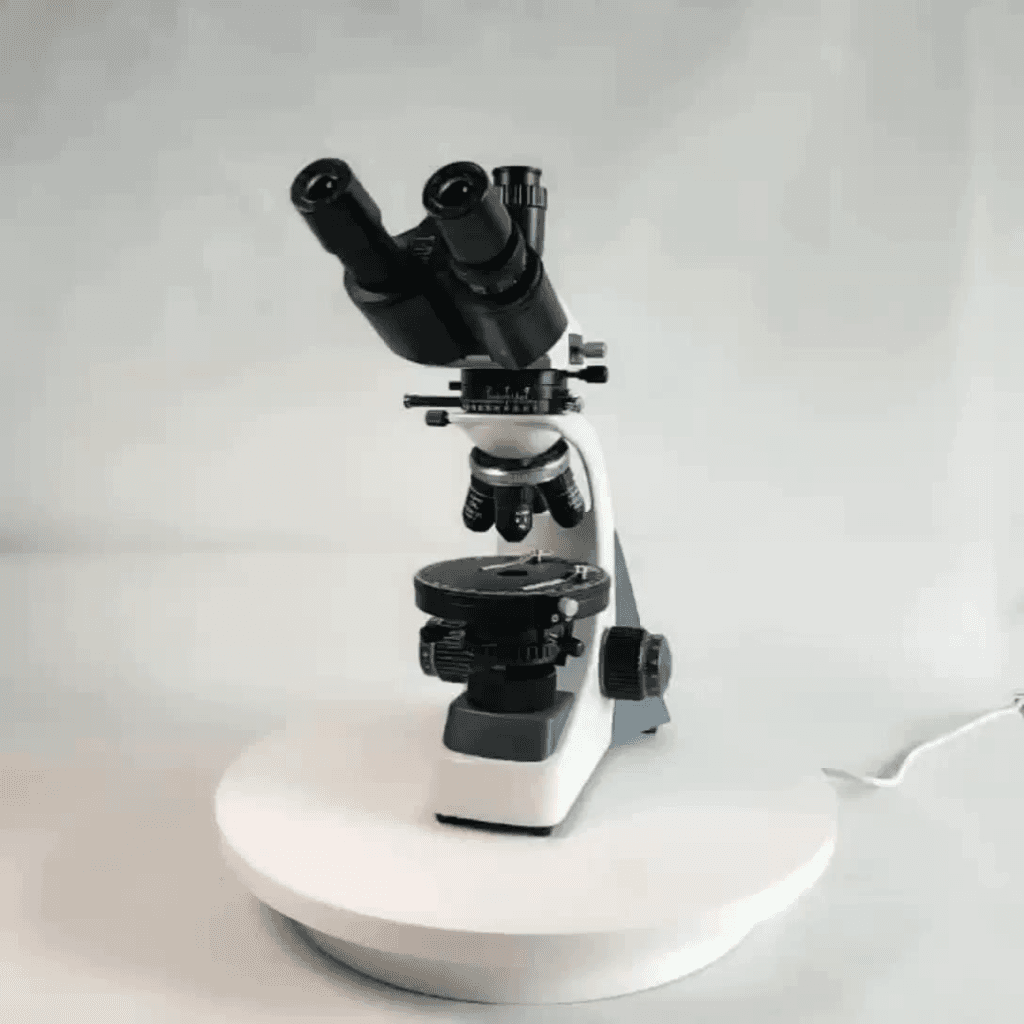
- Polarizer, λ, λ/4 compensator
- Analyer, 0°~90°, push in/ out from optical path conveniently
- Wide-field plan eyepieces: 10X, field number Φ18mm
- Coaxial coarse/fine focus system, minimum division of fine focusing: 10μm
- 360° graduated in 1° increment, rotatable working stage, Φ160mm, minimum vernier division: 6’
Specifications
| Eyepiece |
WF 10X (Φ18mm), WF 16X (Φ13mm) |
| Eyepiece Tube |
Trinocular is inclined 30°, 360° rotatable |
| Achromatic Objective |
4X/0.10,10X/0.25,40X/0.65(S),100X/1.25(O,S) |
| Total Magnification |
40X~1600X |
| Stage |
Rotatable stage, diameter Ø160mm, 360° graduated (in 1°increments), minimum vernier division:6' |
| Nosepiece |
Quadruple (Backward Ball Bearing Inner Locating) |
| Focusing System |
Coaxial coarse/fine focus system, minimum division of fine focusing: 10μm, range: 14mm |
| Analyzer |
0°~90° rotary-type analyzer, push out from the optical path |
| Polarizer |
λ, λ/4 compensator, 360° rotatable |
| Interpupillary Distance |
55~75mm |
| Filter |
B, Y, G |
| Condenser |
Abbe Condenser N.A.1.25, Φ2-Φ30mm with iris diaphragm, φ32 filter |
| Illumination |
Built-in LED Lamp, brightness adjustable |
| Weight |
Net: 4Kg |
Introduction
The Trinocular Polarizing Microscope with LED Light Source is the same as the regular
Trinocular Polarized Microscope; only it is available equipped with an LED Light Source instead of a halogen lamp. LED illumination produces brilliant white light with no color temperature change, and the light waves are outside the UV spectrum making it more comfortable for the user's eyes. Moreover, LEDs have a long lifespan and produce less heat, consuming less power. LED illumination also produces images that publish better.
On the other hand, halogen bulbs are easier to change and illuminates the sample in a color temperature close to sunlight, which gives great color integrity.
Conduct Sciences offers the Trinocular Polarized Microscope with both illuminations to meet desired user preferences.
Apparatus
The microscope weighs 4 kg and is equipped with two eyepieces and an eyepiece tube inclined at 30° and rotatable at 360°. Four achromatic objectives are available, making the total magnification of the microscope between 40X~1600X. It has a rotatable stage and a quadruple nosepiece. The focusing system includes coaxial fine and coarse focusing with a minimum division of 10µm for fine focusing and a range of 14mm. The Polarizing system comprises a 360° rotatable polarizer and a 0°~90° rotary-type analyzer. The built-in LED lamp brightness can be adjusted. An ABBE Condenser and blue, green, and yellow filters are included with the microscope.
Protocol
- Turn the microscope on and place the specimen on the stage and move the stage until the slide is centered under the objective lens
- View it under the desired objective
- Focus the specimen by adjusting the coarse focusing and fine focusing
- Adjust the brightness of the LED lamp until the specimen can be viewed under the desired light conditions
Applications
The Trinocular Polarizing Microscope with LED Light Source can be used for the qualitative and quantitative study of anisotropic specimens such as rocks and minerals. It is useful for studying birefringent samples compared to microscopes utilizing bright-field illumination or fluorescence because of its contrast-enhancing technique.
The microscope can be used for detecting:
- Oriented chromophores (anisotropic amplitude objects) to examine retinal pigments, chloroplast pigments
- Oriented bonds (anisotropic phase objects) to examine Intrinsically birefringent molecules such as collagen, DNA, and myosin and Intrinsically birefringent crystals such as quartz, bone, mica, and calcite.
- Oriented micelles include actin fibrils, microtubules (mitotic spindle), plasma membrane, and cellulose.
- Fluorescence resonance energy transfer (FRET) and fluorescence polarization (FPL)
Strengths and Limitations
The Trinocular Polarizing Microscope with LED Light Source allows users to study anisotropic samples including intrinsically birefringent molecules and crystals. The trinocular head allows users to fit their camera to capture images or videos of the specimen. The LED Light Source brightness can be adjusted. It is more pleasant on the user's eyes than using a halogen lamp. However, LEDs can be expensive and difficult to replace. At the same time, LEDs have a long lifespan, so users should not face this issue often.
Summary
- The Trinocular Polarizing Microscope with LED Light Source is the same as the regular Trinocular Polarized Microscope; only it is available equipped with an LED Light Source instead of a halogen lamp.
- It is useful for studying anisotropic specimens, such as rocks and minerals, as well as birefringent molecules, such as collagen and DNA.
- The LED Light Source provides illumination outside the UV spectrum, which is safer for users' eyes. Moreover, its brightness can be adjusted and has a long lifespan.
References
Hard, R., Hipp, J., Tangrea, M. A., & Tomaszewski, J. E. (2014). Applications of Image Science in Pathology and Cell Biology. https://doi.org/10.1016/B978-0-12-386456-7.07203-8