
Description
Features
Ā – Transmitted illumination system
Ā – Equipped with strain-free plan objectives (center adjustable) and wide field eyepiece
Ā – Coaxial coarse/fine focus system, with tensional adjustable and up stop, minimum division of fine focusing: 2μm.
Ā – Rotatable stage, 360° graduated in 1° increments, minimum retardation resolution 6′ center adjustable and with tightener stage vertical effective movement up to 30mm
Description
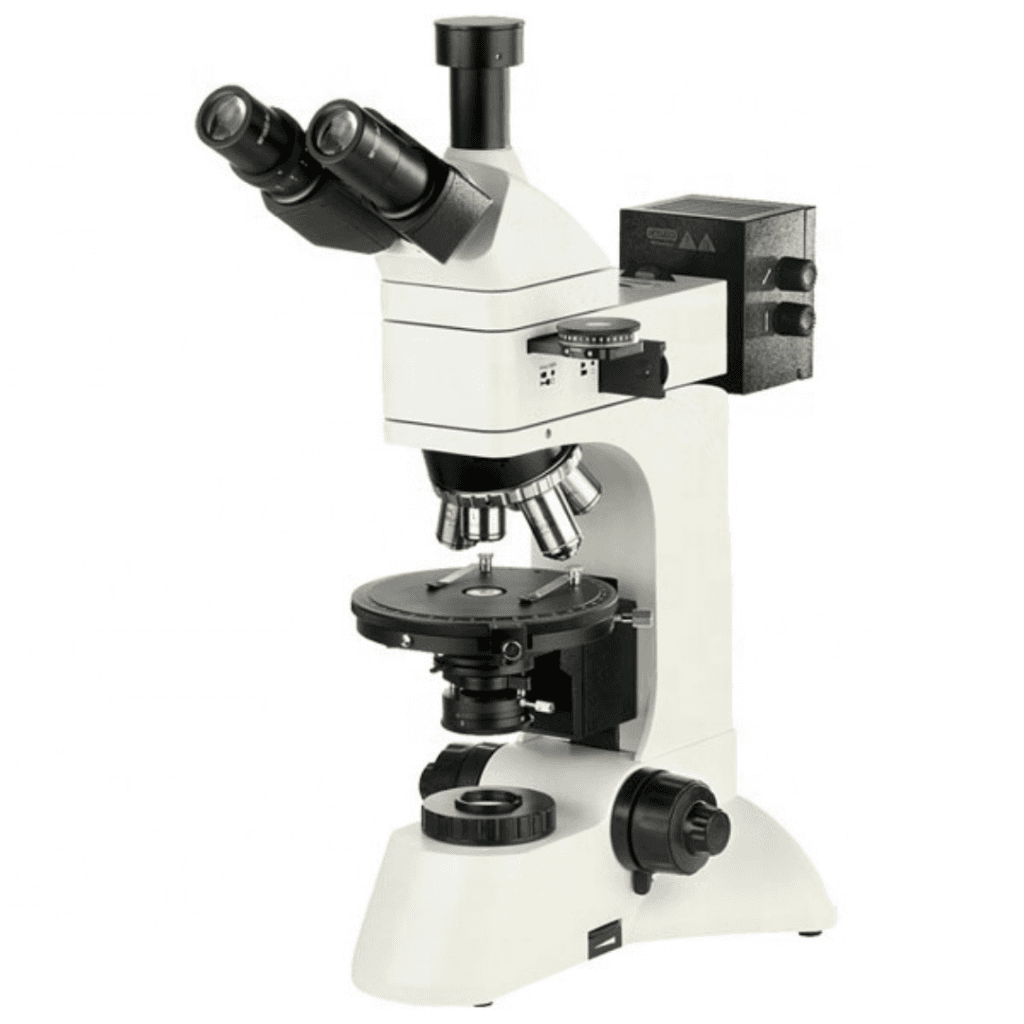
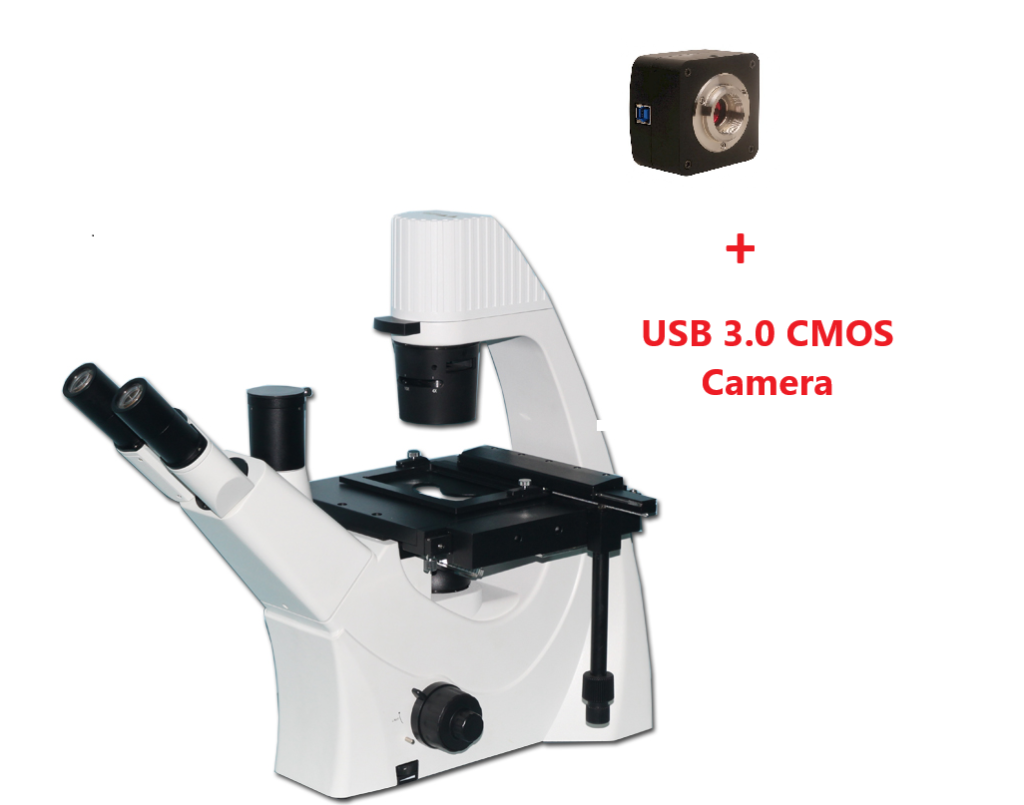
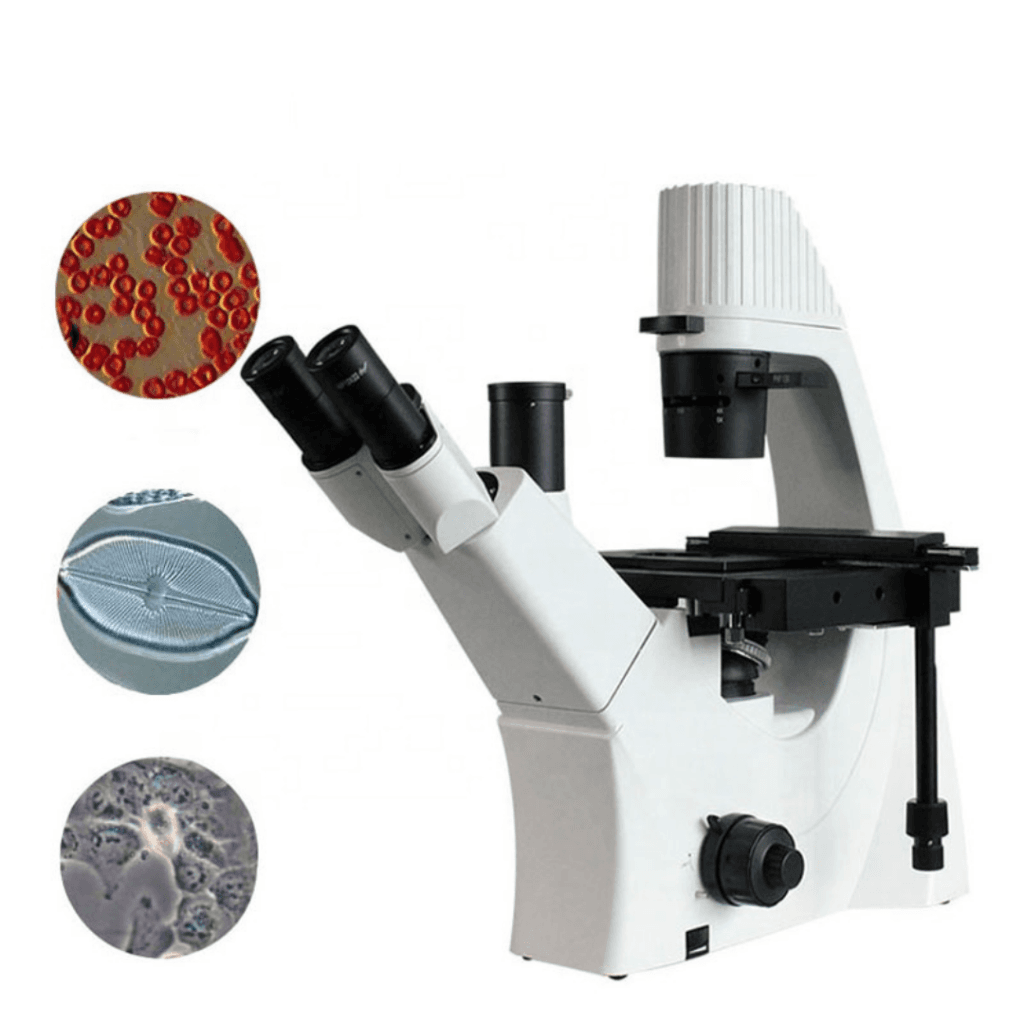
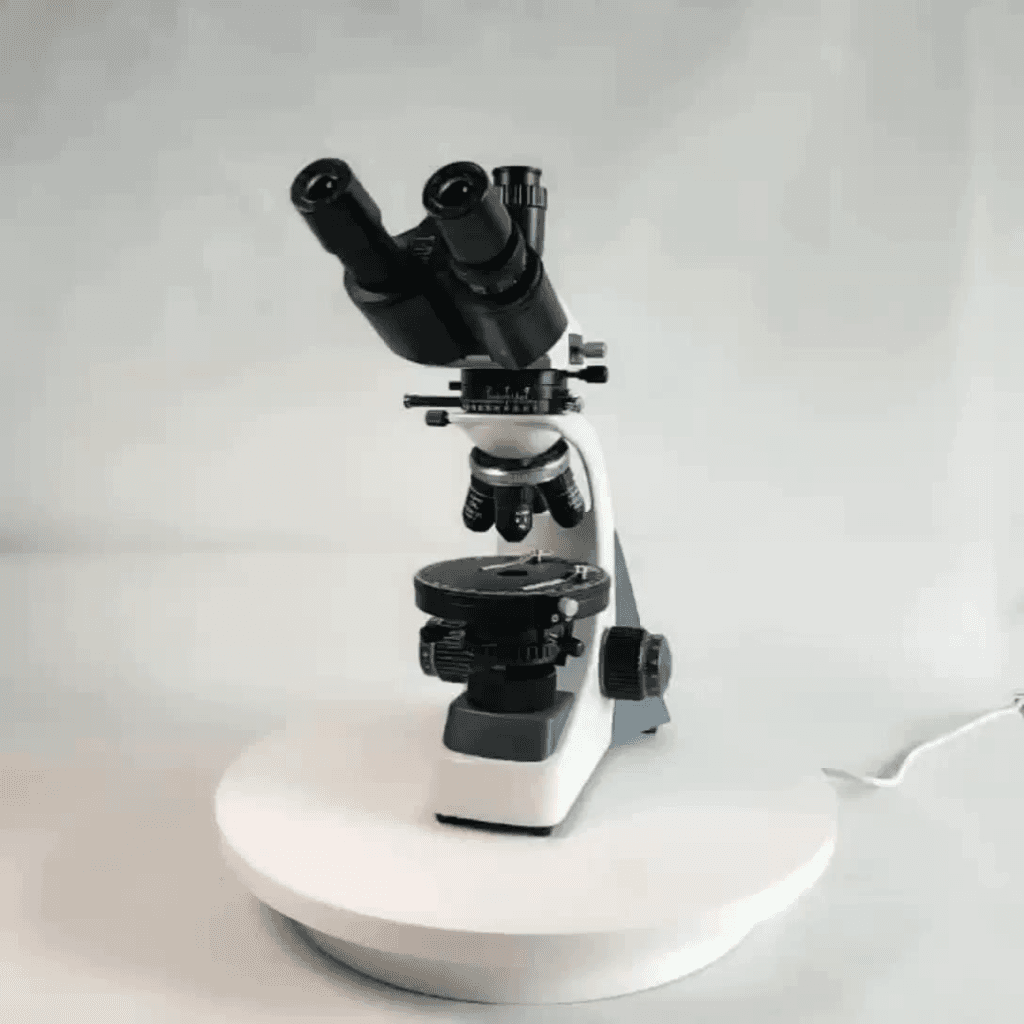
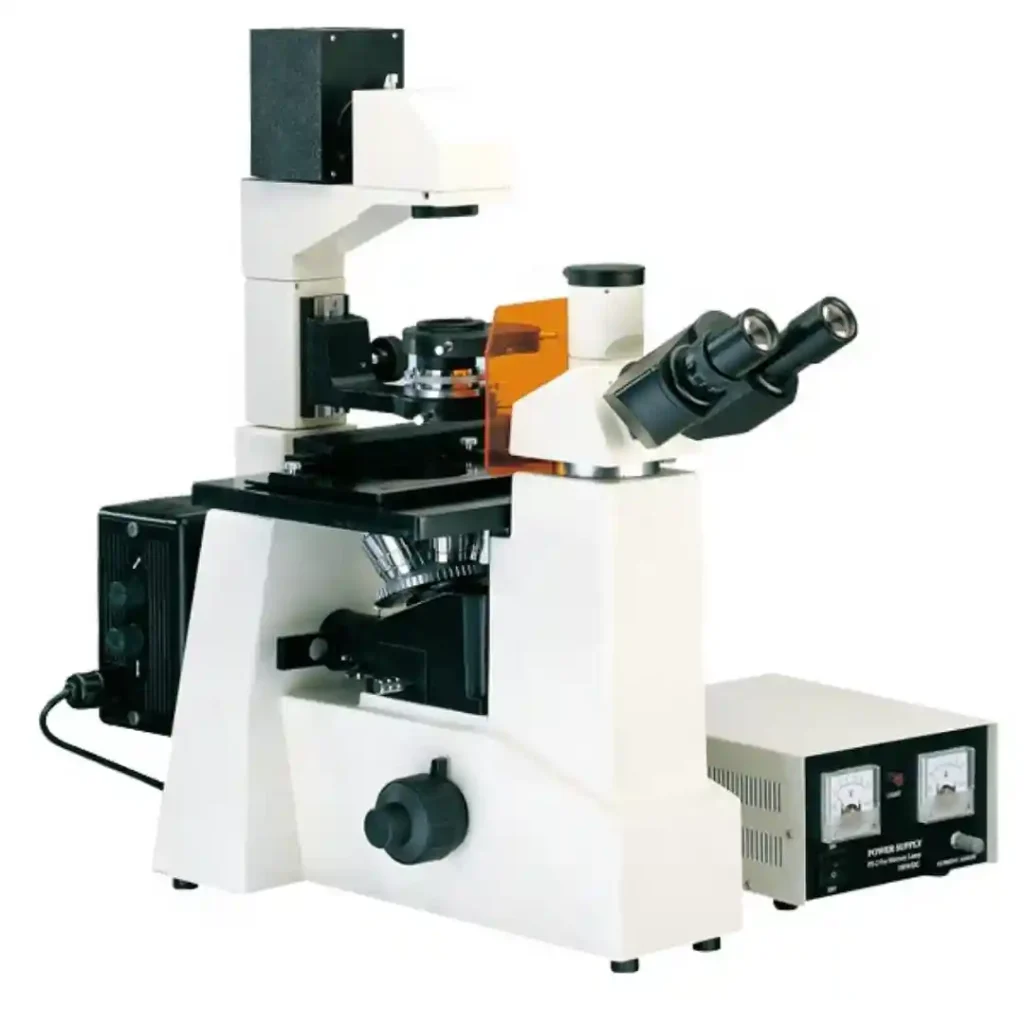
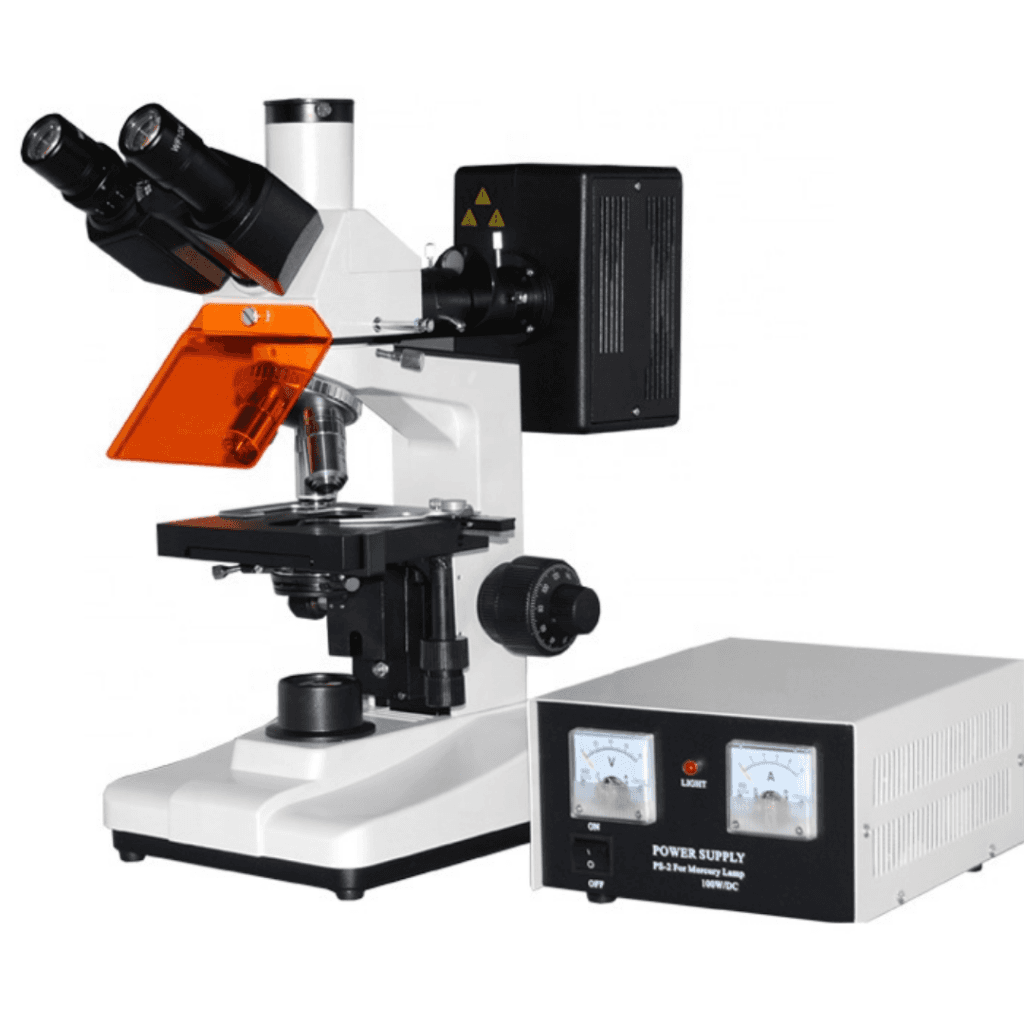
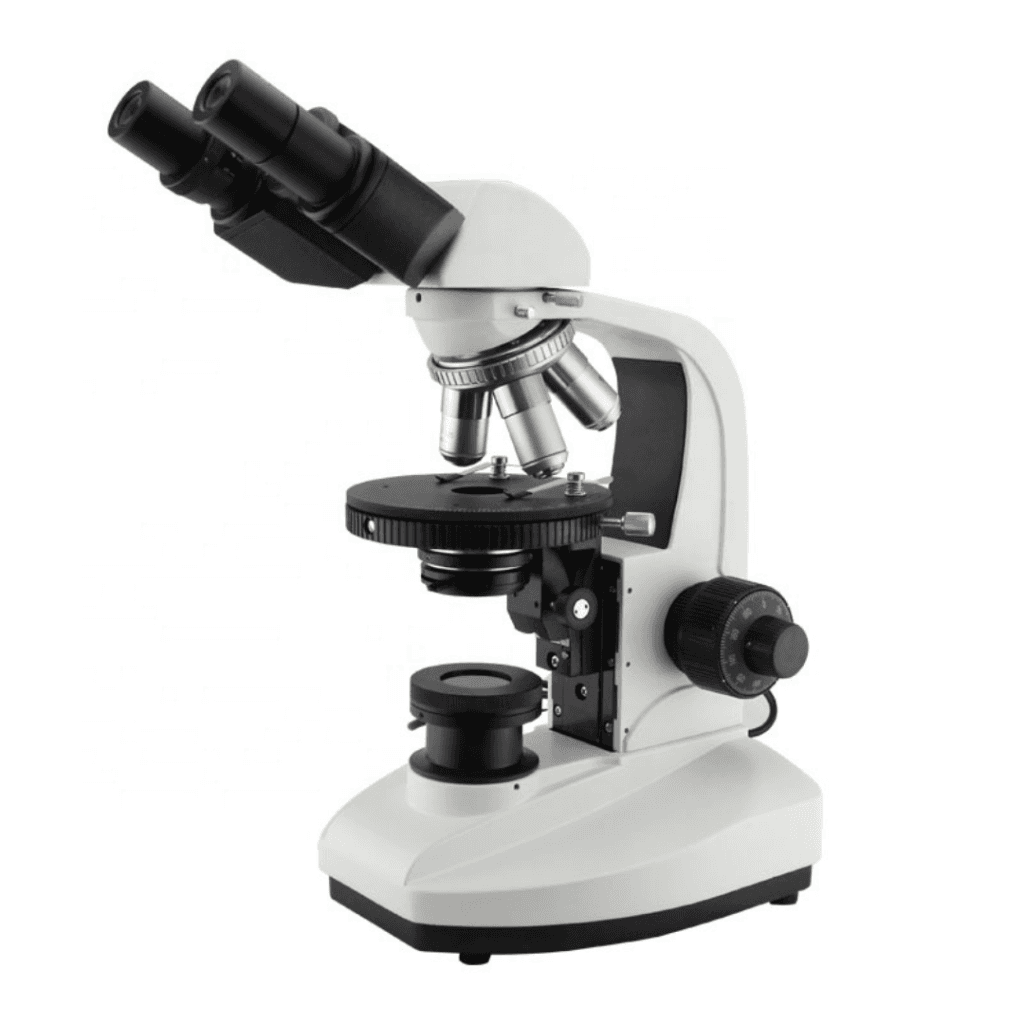
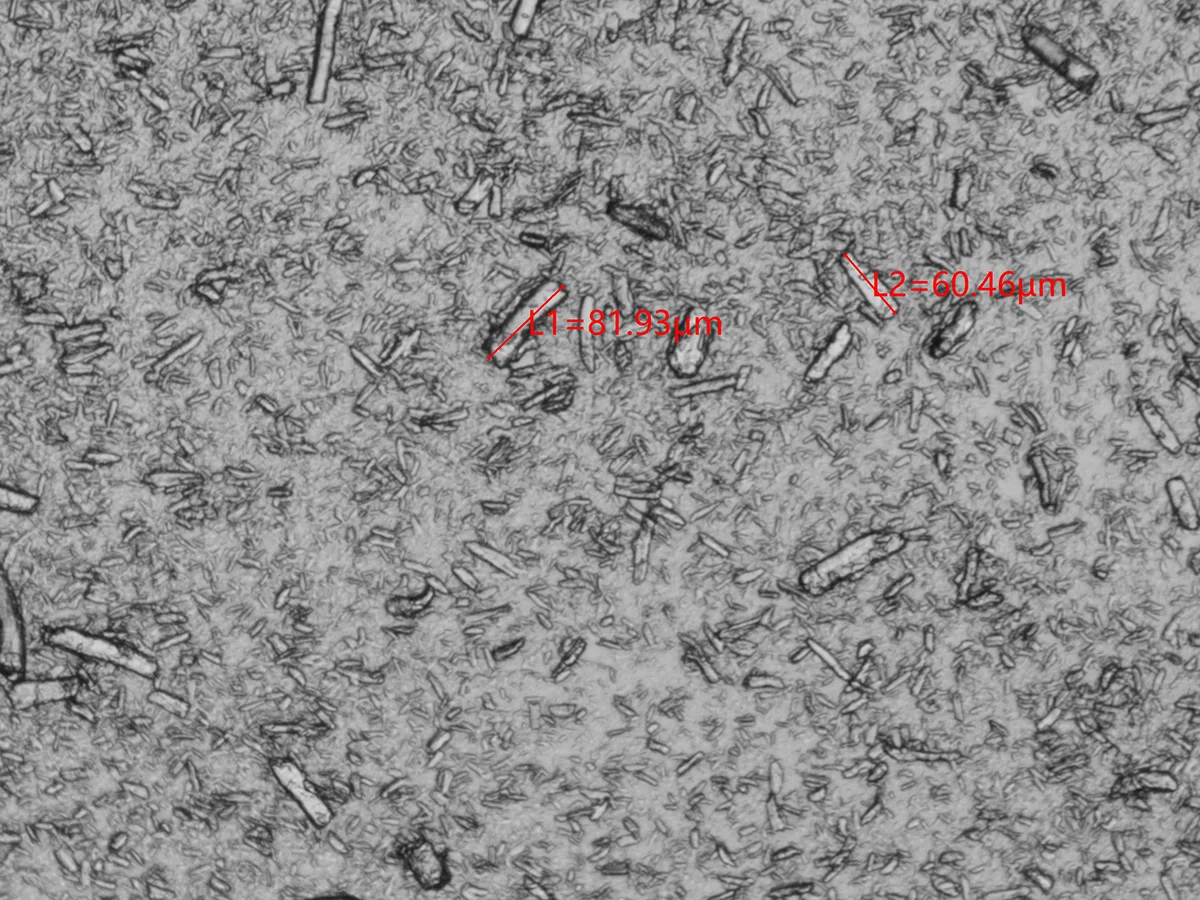
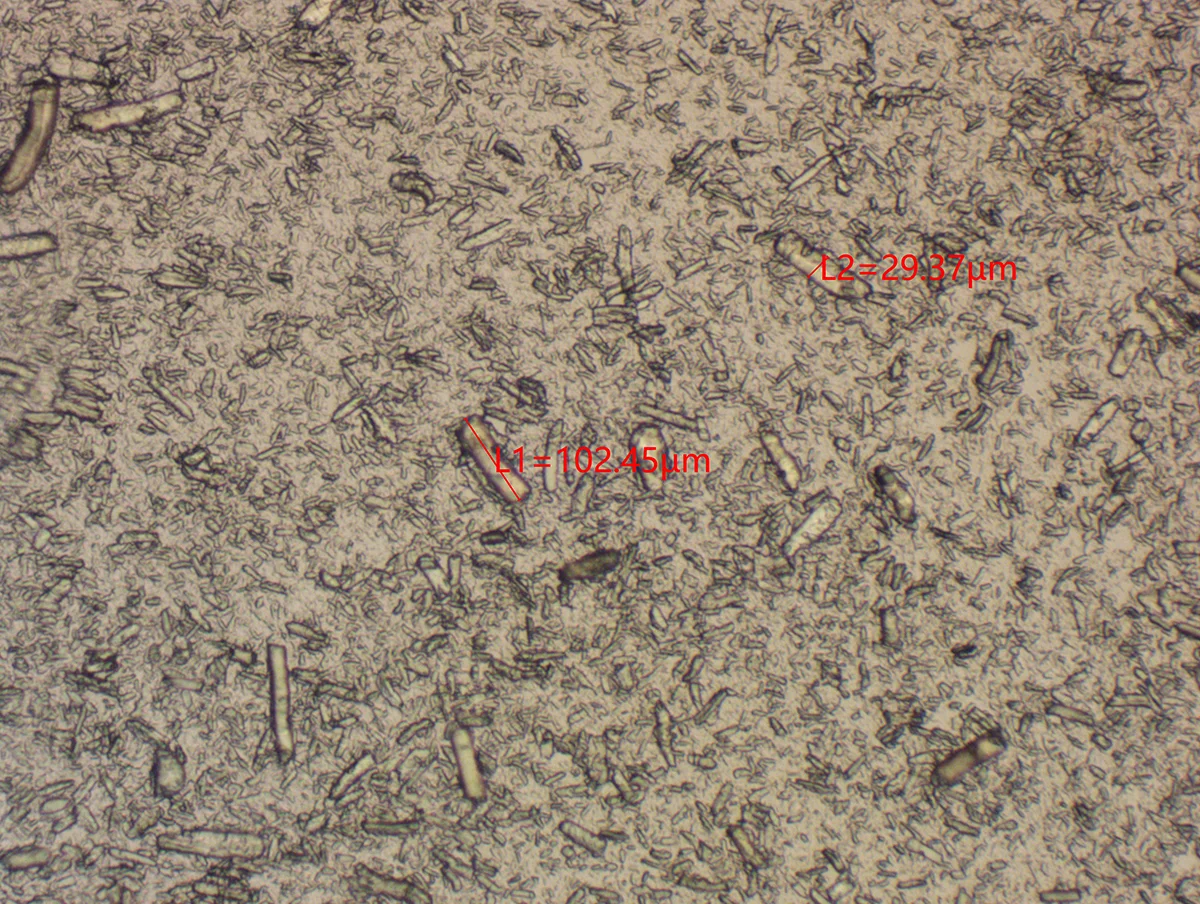
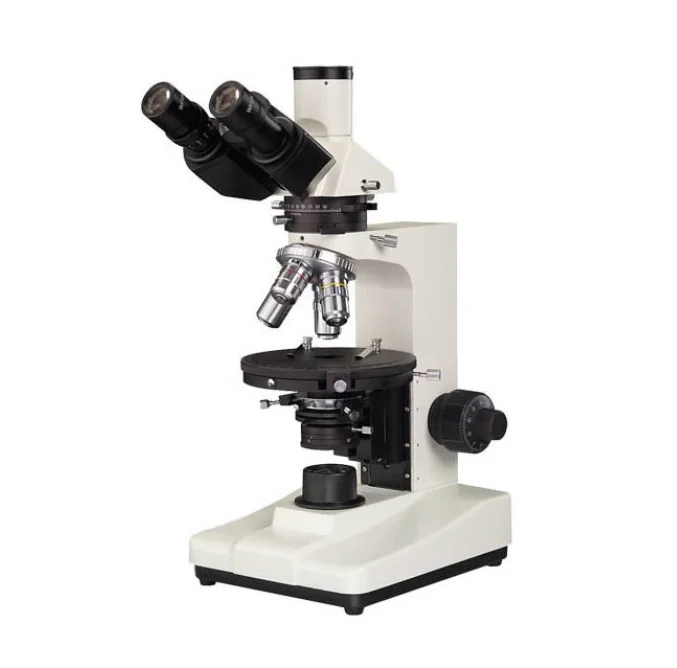
Transmitted Polarization microscope is utilized polarize light to observe and research the matter which have double refraction features, the user can make single polarizing observation, orthoscopic observation, conescopic observation. It is applied in geology, chemicals, physic and leechdom fields. It is also widely used to observe the crystal of liquid macromolecule polymer, biomedical polymer and liquid crystal. It is the ideal instruments for scientific research and universities teaching demo.
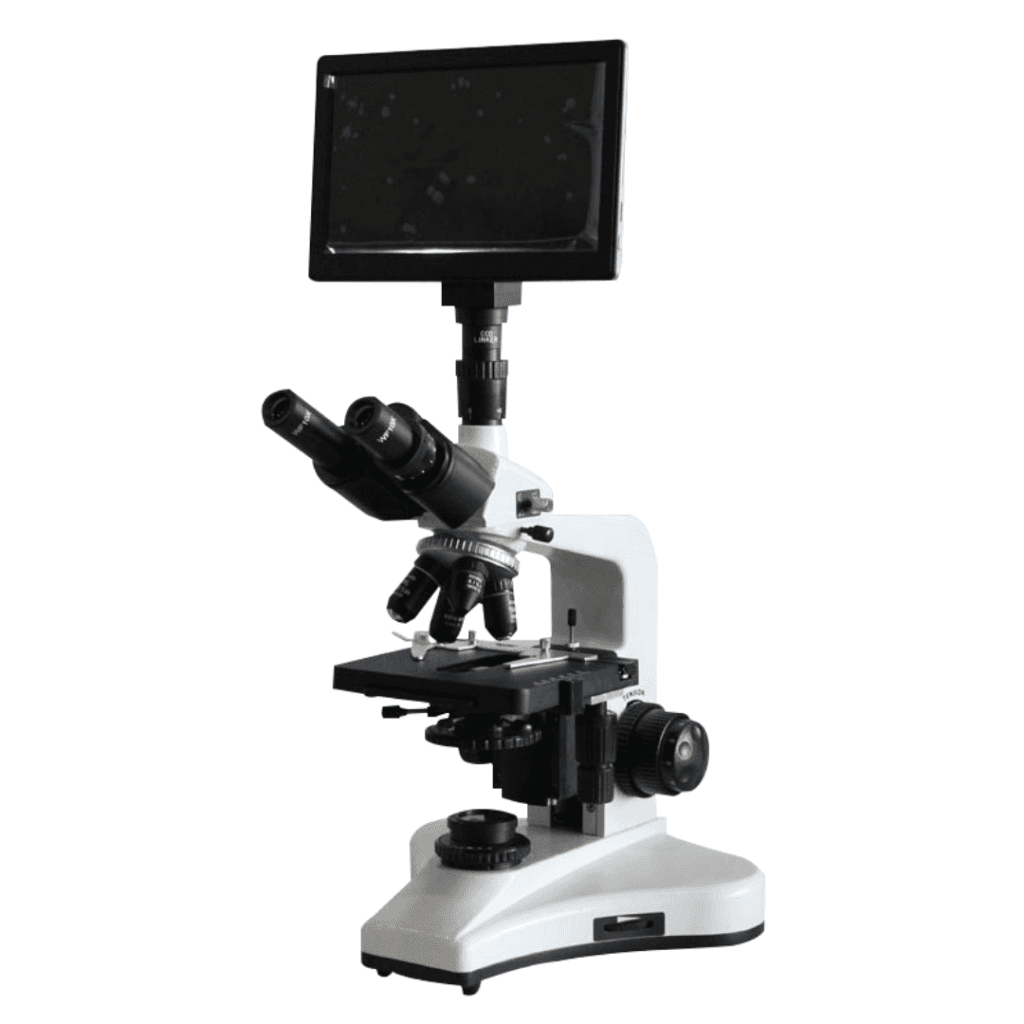
Trinocular, single diopter adjustment, inclined 30°, can send 100% of the image light to top photography port and also can be connected to the camera. 10X wide field plan eyepiece, field Φ18 mm, can provide expanse and smooth observation space.
The intermediate attachment includes the impellent style of analyzer (360° rotatable with scale and fine nonius) which can be taken off from the light path and the impellent style of bertrand lens (center adjustable). It can be added λ compensator, λ/4 compensator or quarts wedge compensator.
Objective, strain-free plan achromatic objective (with or without cover glass), center adjustable, can ensure the center of objective and the rotatable stage completeness superposition.
Rotund rotatable stage, Φ150mm diameter, 360° graduated (in 1° increments), minimum, retardation resolution 6ā, center adjustable and with tightener.
Polarizer, 360° rotatable, having 0, 90 180, 270 four scale, is set under the aperture diaphragm
The illumination system with 6V 20W halogen lamp (brightness adjustable) can provide clear and bright image. The system also includes the collector with field diaphragm.
By adding the appurtenance such as CCD adapter, digital camera adapter and single-reverse digital camera adapter etc. It can achieve high clear observation mode of camera and vidicon.
Warning!
PLEASE DISCONNECT PLUG FROM MAINS SOCKET BEFORE REMOVING THE BOTTOM PLATE, OPENING THE LAMP REPLACEMENT DOOR, OR REMOVING THE LAMP HOUSE
THE POWER CORD PROVIDED WITH THE EQUIPMENT HAS A GROUNDED PLUG. ALWAYS USE THE POWER CORD WITH A PROPERLY GROUNDED WALL OUTLET.
DO NOT EXPOSE THE INSTRUMENT TO HIGH TEMPERATURES OR HUMIDITY. AVOID USING THE INSTRUMENT IN EXTREMELY DUSTY LOCATIONS.
OPERATING TEMPERATURE 5ā TO 35ā
OPERATING HUMIDITY: 20% TO 80% @ 25ā
CAUTION: NEVER IMMERSE THE INSTRUMENT IN WATER OR SOLVENT
CAUTION: DO NOT PUT ANY FOREIGN OBJECTS IN THE FRAME OR INTO ANY MOVING MECHANICAL PARTS
Components
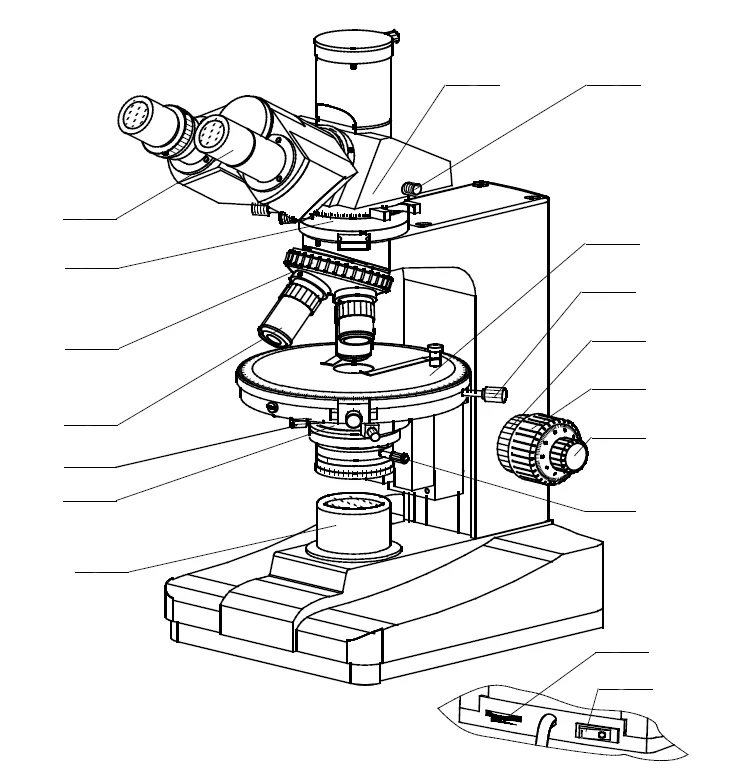
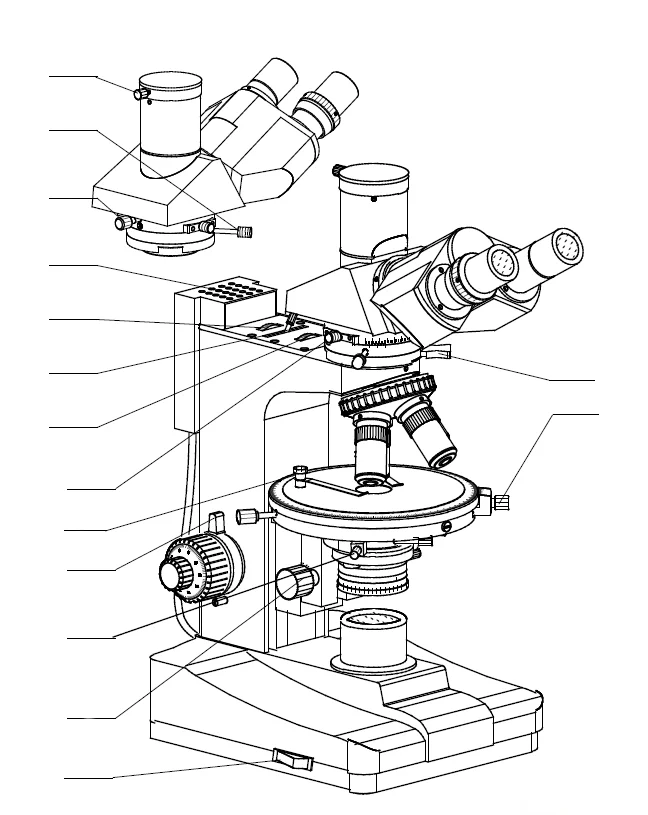
1. Eyepiece
2. Polarizing Intermediate Attachment
3. Nosepiece
4. Center Adjustable Strain-free Plan Achromatic Objectives
5. Condenser Set Screw
6. Polarizing Condenser
7. Collector
8. Power Switch
9. Brightness Control Knob
10. Polarizing Set Screw
11. Fine Focus Control Knob
12. Coarse Focus Control Knob
13. Focus Tensional Adjustment Knob
14. Stage Centering Screw
15. Circular Rotating Stage
16. Push Rod To Direct Image to Binocular Eyepieces or Camera Port
17. Trinocular
1. Adapter Set Screw
2. Push Rob for Analyzer
3. Thumbscrew
4. Lamp House
5. Aperture Diaphragm Adjustment Knob
6. Polarizer
7. Field Diaphragm Adjustment Knob
8. Bertrand Lens Unit
9. Slide Holder
10. Up Stop
11. Polarizing Condenser Centering Screw
12. Substage Adjustment Knob
13. Transmitted / Reflection Illumination Toggle Switch
14. Stage Locking Clamp
15. Compensator
Technical Specifications
Objectives: POL1500 – Strain-free plan achromatic objectives (cover glass, center adjustable)
| Magnification | N.A. | W.D. (mm) | Remark |
|---|---|---|---|
| 4X | 0.10 | 17.9 | standard |
| 10X | 0.25 | 8.8 | |
| 20X | 0.40 | 8.6 | |
| 40X | 0.65 (Spring) | 0.56 | |
| 5X | 0.12 | 18.3 | optional |
| 60X | 0.85 (Spring) | 0.25 | |
| 100X | 1.25 (Spring, Oil) | 0.33 |
Objectives: POL1510/POL1520: Strain-free plan achromatic objectives (no cover glass, center adjustable)
| Magnification | N.A. | W.D. (mm) | Remark |
|---|---|---|---|
| 5X | 0.12 | 18.3 | standard |
| 10X | 0.25 | 8.8 | |
| 20X | 0.40 | 8.6 | |
| 40X | 0.60 (Spring) | 3.73 | |
| 50X | 0.70 | 2.02 | optional |
| 60X | 0.75 (Spring) | 1.34 | |
| 80X | 0.80 | 0.96 | |
| 100X | 0.85 (Spring) | 0.40 |
Nosepiece: Quadruple nosepiece ball-bearing reversed nosepiece with positive click stops and smooth operation.
Eyepieces: 10X Wide field eyepiece and 10X plan division eyepiece (0.10mm/div), Focal Length 25mm, Field Φ18mm.
Stage: Circular rotating stage, Diameter Φ150mm, 360° graduated in 1° increments, minimum retardation resolution 6′ center adjustable and locking clamp for stage rotation.
Condenser: POL1500/POL1520 strain-free Abbe condenser N.A. 1.25 with polarizer and iris diaphragm, polarizer graduated every 45°and marked 0,90,180 and 270.
Polarizing intermediate attachment: Built-in analyzer unit, can be switched in / switched out and adjusted in range of 0° ~ 90° with vernier reading to 12′. Bertrand lens unit can be adjusted center with turret wrench. 1 and 1/4 wave length retardation plate and quarts wedge compensator are provided.
Illumination: Wide voltage range power supply (85-265V 47-60HZ), 6V20W halogen lamp, brightness adjustable.
Setup Instructions
1. Remove all parts from their packing materials and retain the packaging in the event you need to transport the product.
2. Connect the power cord to a suitable power supply.
Basic Operation
1- Illumination Controls
1) The power switch to the illuminator and the brightness control is located on the back of the base. POL1520 the transmitted / reflection illumination toggle switch is located on the left side. The electrical system is fuse protected and the fuse holder is located on the base.
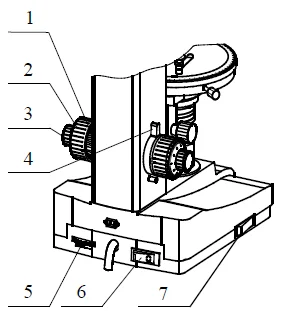
2) Turn on the light with the power switch, see figure 4. If the light does not appear to be ON, check the brightness control to see if itās on a sufficiently low setting.
1. Focus Tensional Adjustment Knob
2. Coarse Focus Control Knob
3. Fine Focus Control Knob
4. Up Stop
5. Brightness Control Knob
6. Power Switch
7. Transmitted / reflection Illumination Toggle Switch
2- Focusing Controls
1) Focusing Adjustment is accomplished by using the large coarse adjustment knobs located comfortably on each side of the frame. Fine adjustment is accomplished using the smaller knobs located on the same focus shaft. This coaxial arrangement allows for easy, precise adjustment without drift or discomfort.
2) Focus Control Turning either of the coarse focus control knobs will raise or lower the stage. The smallest graduation on the fine adjust knob index scale is 2μm of vertical.
3) Focus Tension Adjustment The tension of the coarse focus is adjustable and preset at the factory for ease of use. If you wish to adjust the coarse focus tension, first locate the tension adjustment ring, It is located between the frame and right coarse adjustment knob. Turning the ring toward the rear of the microscope increases the tension, and toward the front of the microscope loosens it. Tension is too high if you experience physical discomfort.
4ļ¼Pre-focusing or Focus Stop Control Use of this feature will insure that the shorter working distance objectives donāt contact the stage or specimen when using the microscope. Its use also simplifies focusing. After focusing on the specimen with the coarse adjustment by low magnification eyepiece, rotation of the lever toward the front of the microscope will set and lower limit on the coarse adjustment movement. After changing specimens or objectives, focusing is easily accomplished by rotating the coarse adjustment knob to reach the pre-focused position, then making fine adjustments with the fine adjustment knob. Focusing movement with the fine adjustment isnāt affected by using the pre-focusing lever.
3- Diopter and Interpupillary Adjustments
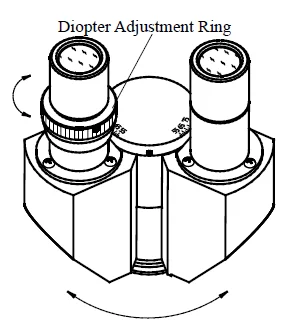
1ļ¼ Diopter Adjustment Proper correction for individual vision is accomplished via the diopter adjustment located at the left eyepiece, see figure 5. Using the 40X magnification objective, bring an image into focus with your right eye only. Once the image is well focused, observe with left eye, make fine adjustments with the diopter adjustment ring to correct for your vision.
2ļ¼ Proper interpupillary distance, or the distance between eyepieces, is crucial to the comfort of the user. Adjusting the interpupillary distance is accomplished through a āfoldingā action of the optical head, at figure 5, allowing for quick and easy adjustment.
4- Circular rotatable stage controls
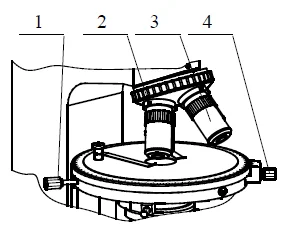
1- Loose the circular rotating stage locking clamp and put a specimen on the circular rotating stage, observe it using 40X objective.
2- Search one of target in field of view, if the target locate in the field like figure 7A, moving the specimen until locate the target in the center of field of view.
3ļ¼ If the circular rotating stage rotating axis is offset optics axis, rotate the stage, the target
moving locus like figure 7B.
4ļ¼ Adjust the circular rotating stage centering screw until the center of locus and the center of field of view are superposition, see figure 7C.
5ļ¼ If change another objective and the target moving locus like figure 7B, can adjust the objective centering screw with turret wrench.
6) Locking clamp for stage rotation can lock the stage in need.
1. Stage Centering Screw
2. Objective Centering Screw
3. Objective
4. Stage Locking Clamp
1. Target
2. Center of Field of View
3. Target Moving Locus
4. Center of Locus
5- POL1500/POL1520 Condenser Alignment Controls.
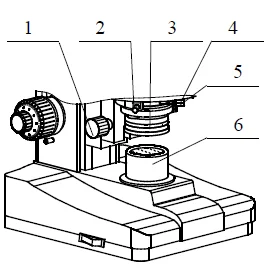
1ļ¼ Condenser Components ā are located below the stage, see the first figure. Abbe condenser is installed in the bracket and tighten by the condenser set screw. The two large centering screws at either side can be adjustable to center the Abbe condenser. The substage adjustment knob can raise and lower the condenser.
2) Condenser Alignment ā to center the Abbe condenser in the optical path, see the figure.
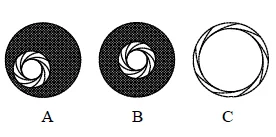
- a. Turn the 40X objective to optics path, close iris diaphragm and lower the Abbe condenser until
observe the image of iris diaphragm. - b. If the Abbe condenser optics axis offset optics system axis, the image of iris diaphragm is similar to the second figure (A). The image may be out of focus and out of center.
- c. Adjust the the substage adjustment knob until the side of image is clear. Adjust the Abbe condenser centering screw until the iris diaphragm locate in the center of field of view, see the second figure (B).
- d. Open the iris diaphragm until the image is almost as large as the field of view, see the figure (C). Raise Abbe condenser again for normal observe.
1. Substage Adjustment Knob
2.Condenser Centering Screw
3. Polarizer
4. Condenser Set Screw
5. Aperture Adjustment Lever
6. Collector
6- Polarization Observation
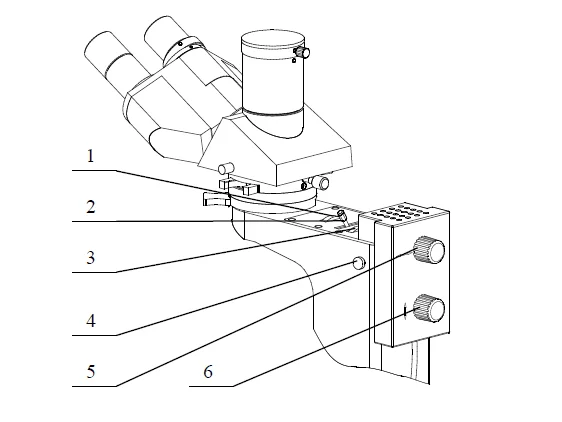
1) The polarizing observation function selected by pushing the analyzer to path. Rotate both of them to ā0ā may let the polarizer and analyzer orthogonally namely polarizer with E-W direction of passage, analyzer with N-S direction of passage.
2) To make path differences, you may push the Ī» compensator, Ī»/4 compensator or wedge compensator to light path.
3) The push rod to the upper left of the trinocular head will send 100% of the image light to the binocular eyepieces or to the top port. It satisfies high-grape photography.
NOTE: While POL1500/POL1520 transmitted observation, you will adjust the polarizer again if the condenser adjusted, see the figure. Set the analyzer to optical path and rotate to ā0ā. Rotate the polarizer to ā0ā, Loosen the condenser set screw, rotate the condenser mark the field very dark. Then lock the screw again.
1. Push Rod For Analyzer
2. Bertrand Lens Unit
3. Compensator
4. Push Rod to Direct Image to Binocular Eyepieces or Camera Port
7- Conoscopic Observation
Conoscopic observation, see the previous figure, selected by pushing the bertrand lens to light path. Adjust the centering screw may let the bertrand lens in the center of view.
8- POL1510/POL1520 Vertical Illumination Alignment
1) The aperture diaphragm near the illuminator house in the vertical illuminator tube may be adjusted slightly to change contrast.
2) To center the incident or vertical lamp.
- a) Put a piece of paper and place it on the stage. Take out one objective form nosepiece and rotate the nosepiece until this objective opening hole is in position over the paper.
- b) Turn the power on and adjust the brightness control to establish sufficient light.
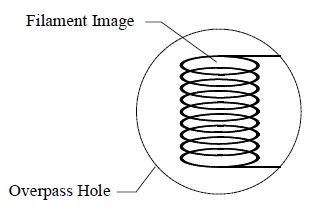
- c) This paper will allow for focusing of the lamp filament on it. If the filament image is not centered in the overpass hole, reduce the aperture diaphragm, adjust the light bulb transverse and vertical adjustment to obtain a uniform image. Adjust the focusing lens lever until a sharp image of the lamp filament is attained, refer to the second figure for this step.
Ā
3) Reinstall the objective again
4) Adjust the focusing control until the image clear. If brightness of field not equality, you may move the light bulb adjustment to make the brightness of field equality.
1. Field Diaphragm Adjustment Knob
2. Polarizer
3. Aperture Diaphragm Adjustment Knob
4. Lamp House Set Screw
5. Light Bulb Transverse Adjustment
6. Light Bulb Vertical Adjustment
Changing the Lamp and the Fuse
1- Changing the lamp of the vertical illuminator POL1510/POL1520
1) Disconnect the power plug and wait to be sure the lamp is cool. Loosen the set screw, remove the lamp house from the body.
2) Pull the old lamp straight out of the socket. Insert the new one into the same fixture. When installing the new lamp, be careful not to touch the glass with your fingers. The new lamp should be supplied in a plastic protective envelope. If not, use a tissue or other medium to grasp the lamp. This will prevent contamination from your hand from reducing the lampās intensity and life. Reinsert the lamp house into the body and retighten the screw. If necessary, you may need to adjust the light bulb transverse and vertical adjustment to center the lamp.
1. Lamp House Set Screw
2. Lamp
3. Lamp Socket
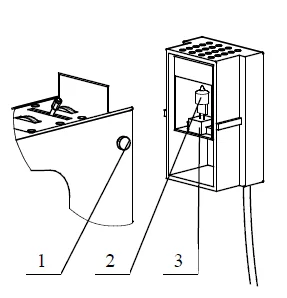
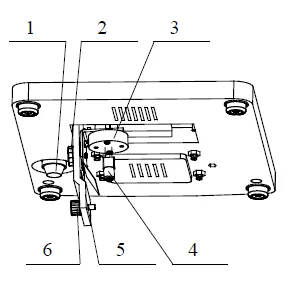
2- Changing the lamp of the transmitted illuminator POL1500/POL1520,
1) Disconnect the power plug and wait to be sure the lamp is cool. Open the lamp door using the lamp door retaining screw as shown in the figure.
2) Pull the old lamp straight out of the socket. Insert the new one into the same fixture. When installing the new lamp, be careful not to touch the glass with your fingers. The new lamp should be supplied in a plastic protective envelope. If not, use a tissue or other medium to grasp the lamp. This will prevent contamination from your hand from reducing the lampās intensity and life. Reinsert the lamp socket into the lamp house and retighten the screw. If necessary, you may need to adjust the lamp centering screw to center the lamp.
1. Fuse Holder
2. Lamp Centering Screw
3. Lamp Socket
4. Lamp
5. Lamp Base
6. Lamp Door Retaining Screw
3- Changing the fuse
3. Changing the fuse: The fuse holder is located on the base, you may change the fuse by removing the fuse holder easily. Put out the bad fuse, mount the new fuse, and tighten the fuse and use. (See the previous Figure)
Preventative Maintenance
1- Cleaning frame and stage
Disconnect the plug from mains socket before cleaning. Clean the frame and stage with a soft cloth moistened with a mild detergent solution. Be sure the instrument is dry before using.

2- Cleaning optical parts
Microscope eyepieces and objectives are coated.
They should not be wiped while dry as dirt or dust may scratch the coating. It is best to remove parts from the frame prior to cleaning. Always blow loose dust away first. Use cotton swabs or lens tissue moistened with a lens cleaner or a small amount of alcohol, then wipe the surface clean with a good quality lens tissue. Solvents such as Xylene should NOT be used as cleaner.
3- Cleaning 100X oil immersion lens
The immersion oil should be removed from the lens at the end of each workday using cotton swabs or lens tissue moistened with a lens cleaner or a small amount of alcohol.
DO NOT DISASSEMBLE OBJECTIVE LENSES.