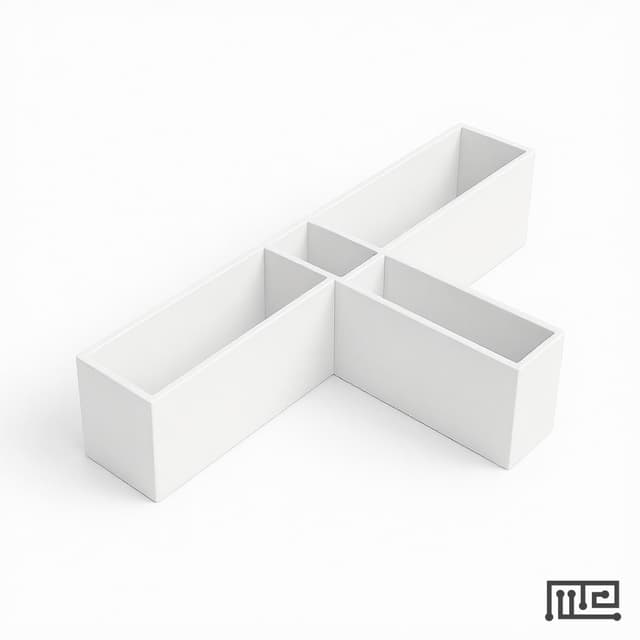
Pig Hebb-Williams Maze
Large-scale behavioral maze (5m x 3m) designed for assessing spatial learning and cognitive function in pigs using the standardized Hebb-Williams paradigm.

Louise Corscadden, PhD
Director of Science · ConductScience
Ask Louise about Pig Hebb-Williams Maze fit, setup, configuration, or quote prep.
Already working with us? Sign in to connect this with My Scientist.
Key Specifications
Full details →- Model fit
- Pig
- SKU family
- ME-8604
- Shipping box
- 43.2 x 38.0 x 27.9 cm
- Ordering
- Online checkout and quote request available
- Category
- Behavioral Mazes
- Build notes
- Confirm accessories, station layout, and support needs before purchase
The Pig Hebb-Williams Maze is a large-scale behavioral testing apparatus designed specifically for assessing spatial learning and cognitive function in pigs. This maze measures 5 meters in length and 3 meters in width, providing adequate space for porcine subjects to navigate complex spatial problems. The apparatus enables researchers to evaluate spatial memory, learning capacity, and problem-solving abilities in swine models.
The maze design follows the established Hebb-Williams paradigm, which presents animals with a series of spatial problems of increasing difficulty. This standardized approach allows for systematic assessment of cognitive performance and learning curves in pigs, making it valuable for studies investigating cognitive development, neurological function, and the effects of experimental interventions on spatial cognition in large animal models.
How It Works
The Hebb-Williams maze operates on the principle of spatial problem-solving through progressive learning challenges. The maze presents pigs with a series of spatial configurations that require navigation from a start point to a goal location while avoiding barriers and dead ends. Each trial configuration increases in complexity, allowing researchers to assess learning curves and cognitive flexibility.
The testing protocol typically involves training phases where pigs learn the basic maze structure, followed by test phases with novel barrier arrangements. Performance is measured through parameters such as path length, navigation time, error frequency, and learning rate across trials. The large dimensions (5m x 3m) accommodate the natural movement patterns and spatial requirements of porcine subjects.
Data collection focuses on spatial navigation strategies, memory retention between sessions, and adaptation to changing maze configurations. This approach provides quantitative measures of cognitive performance that can be analyzed statistically to determine treatment effects or individual differences in spatial learning capacity.
Features & Benefits
Behavioral Construct
- spatial learning
- spatial memory
- cognitive flexibility
- problem-solving
- spatial navigation
Automation Level
- manual
Species
- Pig
Research Domain
- Behavioral Pharmacology
- Developmental Biology
- Learning and Memory
- Neurodegeneration
- Neuroscience
- Toxicology
Compatible Tracking Software
- ConductVision
Shipping weight
- 21.0 lb
Shipping box
- L: 43.2 cm
- W: 38.0 cm
- H: 27.9 cm
| Feature | This Product | Typical Alternative | Advantage |
|---|---|---|---|
| Testing Area Size | 15 square meters (5m x 3m outer dimensions) | Smaller mazes typically offer 1-4 square meters for rodent subjects | Large testing area accommodates natural porcine movement patterns and complex spatial navigation tasks |
| Species Compatibility | Specifically designed for porcine subjects | Most behavioral mazes are scaled for rodent species | Purpose-built dimensions and construction address the unique requirements of pig research models |
| Problem Complexity | Supports full Hebb-Williams paradigm series | Simple maze designs often limited to basic choice tasks | Progressive difficulty levels enable comprehensive cognitive assessment and learning curve analysis |
| Construction Robustness | Heavy-duty construction for large animal use | Standard mazes designed for smaller species with lower structural demands | Durable construction withstands the physical demands of porcine subjects throughout extended use |
This maze offers specialized large-animal cognitive testing capabilities with standardized Hebb-Williams protocols in a 15-square-meter testing area. The porcine-specific design addresses the unique spatial and structural requirements of swine research that cannot be met by standard rodent behavioral apparatus.
Practical Tips
Allow pigs to habituate to the maze environment for 10-15 minutes before formal testing to reduce stress-related performance effects.
Why: Initial exploration reduces anxiety and provides more accurate measures of cognitive performance rather than stress responses.
Inspect all barrier connections and wall joints daily during active testing periods, as pig subjects may apply significant force during navigation.
Why: Regular inspection prevents structural failures that could compromise subject safety and data integrity.
Record multiple camera angles to capture complete navigation paths and identify subtle behavioral strategies that single-view recording might miss.
Why: Comprehensive video coverage enables more accurate error scoring and detailed analysis of spatial navigation strategies.
Establish baseline performance measures with pilot subjects before beginning experimental protocols to set appropriate learning criteria.
Why: Individual variation in porcine cognitive abilities requires baseline establishment for meaningful treatment effect detection.
Ensure all barrier edges are rounded or padded to prevent injury during rapid navigation attempts or collision with obstacles.
Why: Pig subjects may move quickly through the maze, and sharp edges pose injury risks that could affect subsequent performance.
If subjects show reluctance to explore, check for environmental stressors such as excessive noise, lighting, or unfamiliar odors in the testing area.
Why: Pigs are sensitive to environmental changes that can significantly impact motivation and cognitive performance.
Randomize starting positions and goal locations when possible to prevent subjects from developing non-spatial solution strategies.
Why: Spatial randomization ensures subjects rely on cognitive mapping rather than simple motor routines or environmental cues.
Setup Guide
What’s in the Box
- Outer wall panels and assembly hardware
- Moveable barrier components (typical)
- Assembly instructions and safety guidelines
- Basic protocol handbook for Hebb-Williams testing (typical)
- Hardware for secure wall connections (typical)
Warranty
ConductScience provides a standard one-year manufacturer warranty covering structural defects and material failures under normal research use conditions. Technical support includes setup assistance and protocol guidance for optimal maze utilization.
Compliance
References
Background reading relevant to this product:
What is the maximum weight capacity for porcine subjects in this maze?
Consult the product datasheet for specific weight limitations. The maze is constructed to accommodate adult pigs, but maximum capacity depends on construction materials and safety factors.
How many different Hebb-Williams problems can be configured with this maze?
The modular barrier system supports the full series of standard Hebb-Williams problems, typically ranging from Problem 1 (direct path) through Problem 12 (complex multi-barrier). The exact number depends on barrier set included.
What behavioral parameters can be measured during testing?
Standard measures include path length, navigation time, number of errors (wrong turns or barrier contacts), latency to goal, and learning curves across trials. Video tracking systems can provide additional spatial and temporal analyses.
How long does maze assembly typically require?
Initial assembly usually requires 2-4 hours depending on configuration complexity and team size. Subsequent barrier reconfigurations between problems typically take 5-15 minutes.
Is the maze compatible with automated tracking systems?
The open-top design facilitates overhead video recording and automated behavioral tracking software. Specific compatibility depends on the tracking system's requirements for spatial resolution and subject size.
What maintenance is required between testing sessions?
Regular cleaning and sanitization of all surfaces, inspection of barrier stability, and verification of wall integrity. Replace any damaged components before subsequent testing sessions.
Can the maze be modified for other large animal species?
While designed specifically for pigs, the maze may accommodate other large species depending on size and behavioral characteristics. Consult with technical support for species-specific modifications.
Have a question about this product?
Have a question? Just ask.
Send it over and we'll email you a personalized answer — no call, no scheduling.
Prefer to talk it through?
Accessories
Enhance your setup with compatible accessories