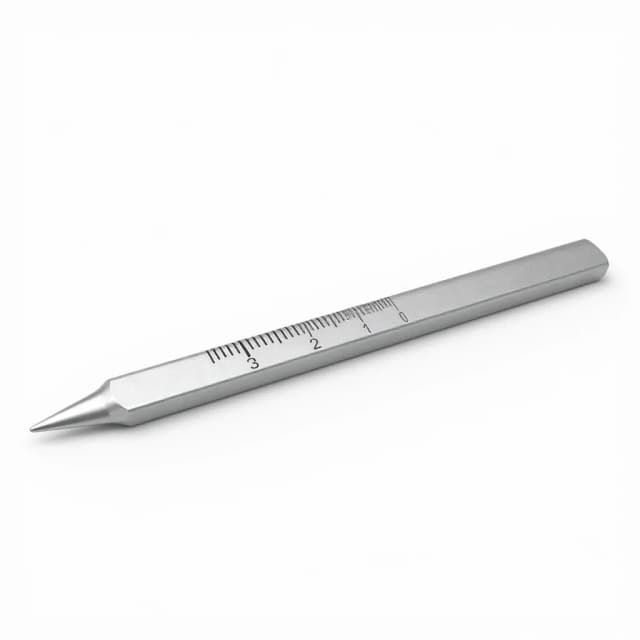
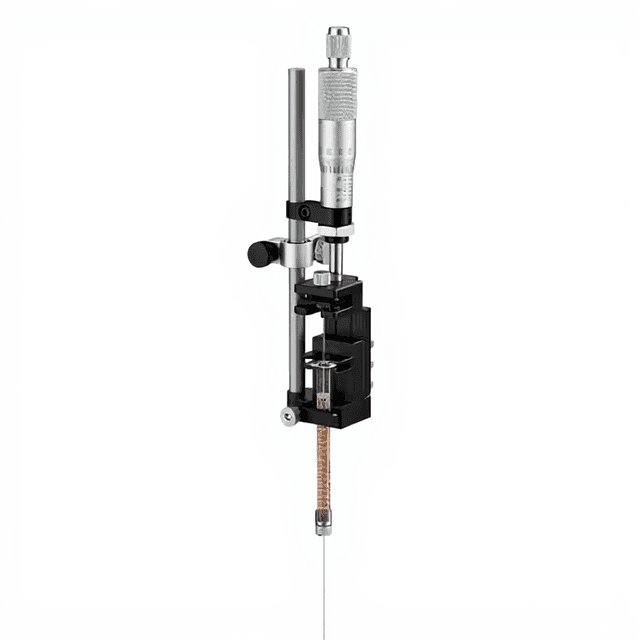
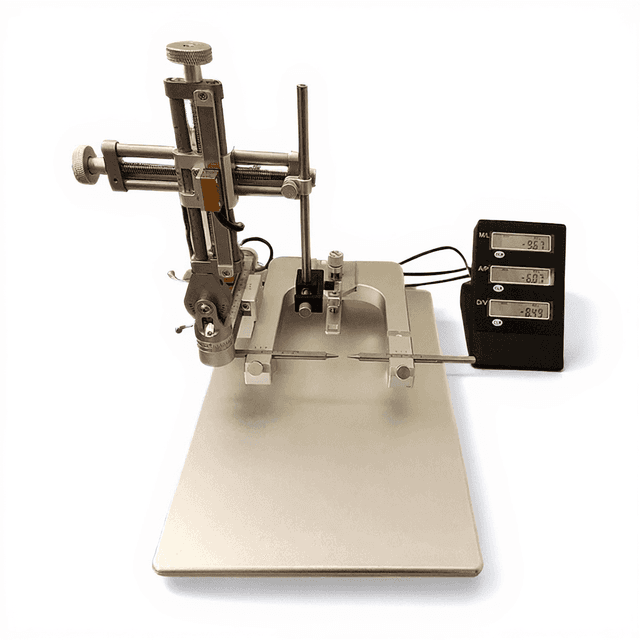
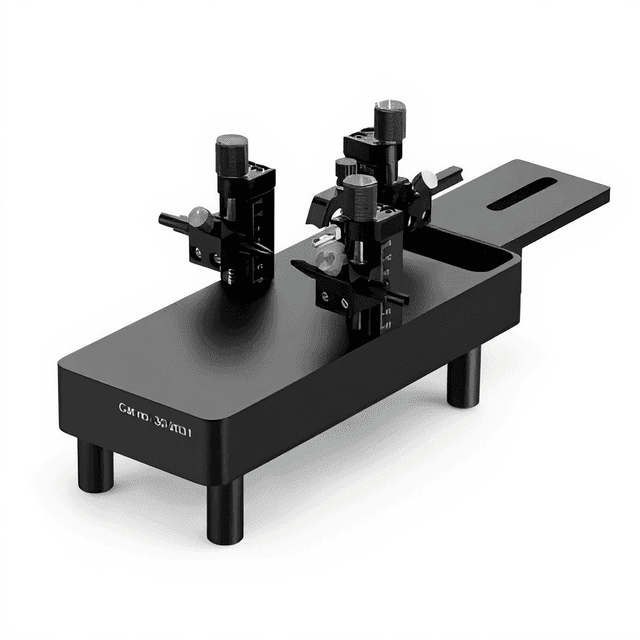
Stereotaxic Spinal Cord Adaptor (for SCI experiments) mouse and rat
Precision stereotaxic adaptor for standardized spinal cord injury procedures in mouse and rat models, featuring multi-directional positioning and lateral spinal stabilization to eliminate respiratory artifact.

Louise Corscadden, PhD
Director of Science · ConductScience
Ask Louise about Stereotaxic Spinal Cord Adaptor (for SCI experiments) mouse and rat fit, setup, configuration, or quote prep.
Already working with us? Sign in to connect this with My Scientist.
Key Specifications
Full details →- Model fit
- Mouse, Rat
- SKU family
- CS-M/RSA- 68094
- Shipping box
- 33.0 x 12.0 x 17.0 cm
- Ordering
- Quote-reviewed before fulfillment
- Category
- Stereotaxic Accessories
- Build notes
- Confirm accessories, station layout, and support needs before purchase
The Stereotaxic Spinal Cord Adaptor is a precision positioning system designed for standardized spinal cord injury (SCI) procedures in mouse and rat models. This specialized adaptor integrates with stereotaxic systems to provide stable spinal column fixation during contusion, compression, and transection experiments. The system addresses critical methodological challenges in neurotrauma research by eliminating depth errors caused by respiratory movement and maintaining consistent positioning across experimental subjects.
The adaptor features multi-directional adjustment capabilities (vertical/lateral/dorsal and anterior/posterior) and includes a three-axis micro-manipulated rotatable platform with universal adjustment mechanisms. The lateral support design stabilizes the spinal cord from the lower sides of the spine, preventing collapse during impact procedures and ensuring reproducible injury parameters. This configuration is essential for generating consistent lesion characteristics required for therapeutic efficacy studies and pathophysiology investigations.
How It Works
The stereotaxic spinal cord adaptor operates on the principle of multi-axis mechanical stabilization to maintain precise positioning during spinal cord injury procedures. The system employs lateral support mechanisms that engage the lower sides of the vertebral column, creating a stable platform that prevents dorsoventral displacement caused by respiratory excursion or external forces during impact delivery.
The three-axis micro-manipulated platform provides independent control over vertical, lateral, and anterior-posterior positioning with micrometer-scale precision. The universal adjustment device enables fine-tuning of spinal segment alignment to ensure perpendicular impact trajectories, critical for generating consistent injury biomechanics. The rotatable platform component allows for optimal positioning of different spinal levels (cervical, thoracic, lumbar) while maintaining the anatomical relationships necessary for reproducible lesion geometry.
During operation, the adaptor maintains the spinal column in a fixed position while the impact device delivers controlled mechanical trauma. The lateral stabilization prevents the characteristic collapse and deformation that occurs with unsupported positioning, ensuring that impact force is transmitted directly to the target tissue rather than being dissipated through vertebral movement or soft tissue displacement.
Features & Benefits
Platform Dimensions
- 9 inches x 4.8 inches x 1 inch
Adjustable Directions
- vertical/lateral/dorsal and anterior/posterior
Spinal Support
- supports spinal cord from lower sides to avoid depth error from breathing/impact collapse
Included Components
- three-axis micro-manipulated rotatable platform with universal adjustment device
Automation Level
- manual
Species
- Mouse
- Rat
Dimensions
- 12.5 inches x 4.8 inches x 5.5 inches
Research Domain
- Behavioral Pharmacology
- Motor Function
- Neurodegeneration
- Neuroscience
- Pain Research
Shipping weight
- 5.51 lb
Shipping box
- L: 33.0 cm
- W: 12.0 cm
- H: 17.0 cm
| Feature | This Product | Typical Alternative | Advantage |
|---|---|---|---|
| Spinal Stabilization Method | Lateral support system engaging lower sides of vertebral column | Basic clamps or improvised restraints often compress from dorsal/ventral directions | Prevents respiratory artifact and tissue deformation that compromises impact consistency |
| Positioning Control | Three-axis micro-manipulated platform with universal adjustment device | Limited adjustment mechanisms with manual positioning | Enables micrometer-scale precision for reproducible lesion placement across subjects |
| Species Compatibility | Single system accommodates both mouse and rat models | Separate systems often required for different species | Reduces equipment costs and setup time while maintaining protocol standardization |
| Platform Working Space | 9 x 4.8 inch surgical platform with integrated positioning | Smaller platforms with limited surgical access | Provides adequate space for microsurgical procedures while maintaining spinal stabilization |
| Multi-directional Adjustment | Vertical, lateral, dorsal, and anterior-posterior positioning control | Fewer adjustment axes with manual realignment requirements | Accommodates different spinal segments and impact angles without repositioning animal |
This adaptor system provides specialized spinal stabilization and multi-axis positioning control designed specifically for standardized spinal cord injury procedures. The lateral support mechanism addresses the critical methodological challenge of respiratory artifact while the integrated micro-manipulation enables reproducible lesion placement across experimental subjects.
Practical Tips
Verify perpendicular alignment of the impact device to the spinal cord surface using the micro-manipulator adjustment before each procedure.
Why: Non-perpendicular impacts create asymmetric lesions and compromise injury model validity.
Clean positioning threads and lubricate moving components monthly to maintain micrometer-scale precision.
Why: Accumulated debris or corrosion in adjustment mechanisms reduces positioning accuracy and repeatability.
Engage lateral support clamps gradually to avoid compression of major blood vessels while achieving stable spinal fixation.
Why: Excessive compression can compromise spinal cord perfusion and introduce ischemic confounds to the injury model.
Document all positioning coordinates and adjustment settings for each animal to enable protocol standardization.
Why: Consistent positioning parameters are essential for generating comparable lesions across experimental subjects.
If impact depth varies between animals, check that lateral support is engaging the vertebral column rather than soft tissue.
Why: Soft tissue engagement allows continued respiratory movement and position instability during impact delivery.
Ensure adequate anesthetic depth before positioning to prevent movement during the stabilization and impact procedures.
Why: Animal movement during positioning can cause injury to the spinal cord or compromise surgical sterility.
Verify consistent distance between impact device and spinal cord surface across all animals using the universal adjustment mechanism.
Why: Variable impact distances introduce force delivery inconsistencies that affect lesion severity and reproducibility.
Setup Guide
What’s in the Box
- Stereotaxic spinal cord adaptor main unit
- Three-axis micro-manipulated rotatable platform
- Universal adjustment device
- Lateral support clamps
- Stereotaxic mounting hardware (typical)
- User manual and setup instructions (typical)
- Calibration tools (typical)
Warranty
ConductScience provides a comprehensive one-year manufacturer warranty covering materials and workmanship, with technical support for setup optimization and troubleshooting of positioning procedures.
Compliance
What spinal segments can be accessed with this adaptor system?
The multi-directional adjustment capabilities and rotatable platform accommodate all major spinal regions including cervical, thoracic, and lumbar segments. The universal adjustment device enables positioning for specific vertebral levels commonly targeted in SCI research (C4-C5, T9-T10, L1-L2).
How does the lateral support system prevent respiratory artifact?
The lateral clamps engage the lower sides of the vertebral column, creating a stable platform that prevents dorsoventral displacement during breathing. This maintains consistent tissue-to-impact device distance, eliminating the depth errors that occur with unsupported spinal positioning.
Is the adaptor compatible with different impact force requirements?
The stabilization system is designed to work with various impact devices and force parameters commonly used in SCI research. The three-axis platform maintains alignment regardless of impact magnitude, supporting both mild contusion (50-75 kdyn) and severe injury protocols (200+ kdyn).
What maintenance is required for the positioning mechanisms?
Regular cleaning of adjustment threads and periodic lubrication of moving components maintains precision. The micro-manipulator should be calibrated periodically using precision measurement tools to ensure micrometer-scale accuracy is maintained.
Can the system accommodate age-related size variations in experimental animals?
The universal adjustment device and multi-directional positioning enable accommodation of both juvenile and adult animals within the mouse and rat size ranges. The lateral support clamps are adjustable to fit different vertebral column diameters while maintaining stabilization.
How does positioning reproducibility compare to freehand surgical approaches?
The stereotaxic mounting and micro-manipulated platform eliminate operator-dependent positioning variability, providing consistent lesion placement with micrometer precision compared to the millimeter-scale variability typical of manual positioning methods.
What surgical access does the platform design provide?
The 9 x 4.8 inch platform provides adequate space for laminectomy procedures and surgical instrument access while maintaining spinal stabilization. The lateral support design does not interfere with standard microsurgical approaches to the spinal cord.
Have a question about this product?
Have a question? Just ask.
Send it over and we'll email you a personalized answer — no call, no scheduling.
Prefer to talk it through?